
The Last Common Ancestor of Homo sapiens, Neanderthals and Denisovans
Some fossil remains discovered near Casablanca, dating back to around 773,000 years ago, may belong to an African population that lies at the base of the evolutionary trajectory from which the most recent human species, including our own, originated
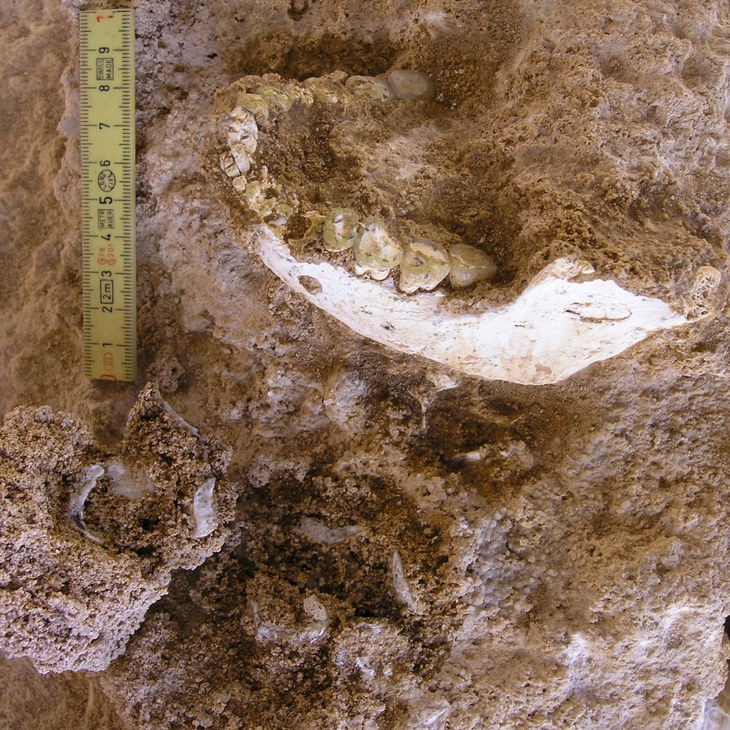
Some human fossil remains found near Casablanca, in Morocco, may belong to the last common ancestor of Homo sapiens, Neanderthals and Denisovans. The remains were analysed by an international team of researchers, who were able to obtain high-resolution geomagnetic dating, establishing that they date to around 773,000 years ago.
The results of the study — published in Nature — show that the fossil remains display archaic traits consistent with a possible African human population that was a sister group to Homo antecessor, a hominin species that lived during the Early Pleistocene (between 1.2 million and 800,000 years ago).
“These results identify an African population that lies at the base of the evolutionary pathway from which our species, Homo sapiens, originated,” says Stefano Benazzi, Professor at the Department of Cultural Heritage of the University of Bologna, one of the study’s authors. “It is an important discovery, offering new insights into the shared ancestry of Homo sapiens, Neanderthals and Denisovans.”
The analysed remains were uncovered in the Grotte à Hominidés, a site located in the Thomas Quarry I area, on the outskirts of Casablanca. This region has long been known as one of the richest African deposits of Pleistocene archaeological and palaeontological remains.
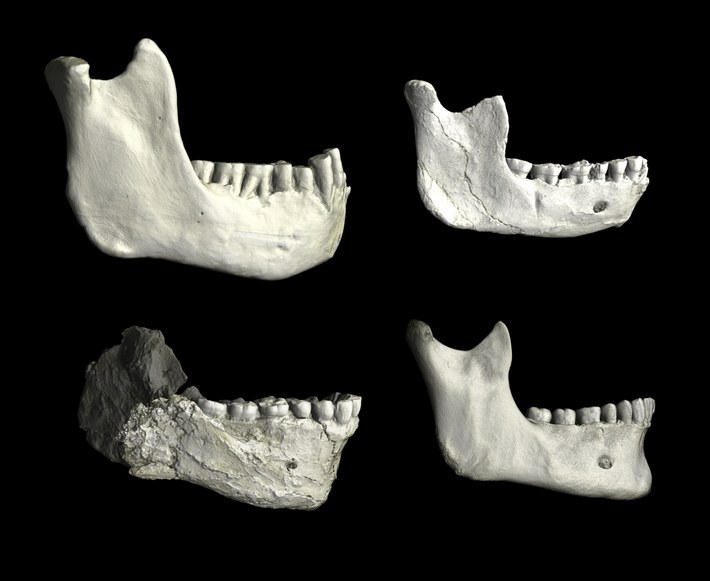
The researchers focused in particular on a series of fossil remains including two adult mandibles, one belonging to a child, several isolated teeth, and vertebrae.
“Analyses of these remains revealed a mosaic of archaic traits, with many features reminiscent of hominins of comparable age found in Spain — the so-called Homo antecessor,” says Rita Sorrentino, a researcher at the Department of Biological, Geological and Environmental Sciences of the University of Bologna, and co-author of the study. “The two populations, however, already appear clearly distinct, implying that any contacts must have occurred at earlier times.”
The remains from the Grotte à Hominidés in Morocco are almost contemporaneous with those of Homo antecessor in Spain, but are much older — by at least 400,000 years — than the earliest fossil evidence of Neanderthals, Denisovans and early Homo sapiens.
“By combining archaic African traits with features approaching the Eurasian and African morphologies of the Middle Pleistocene, the hominins from the Grotte à Hominidés provide essential clues about the last common ancestor of Homo sapiens, Neanderthals and Denisovans,” adds Stefano Benazzi. “Based on genetic evidence, we can estimate that this common ancestor lived between 765,000 and 550,000 years ago, and the remains we analysed fall within the earliest part of this time range.”
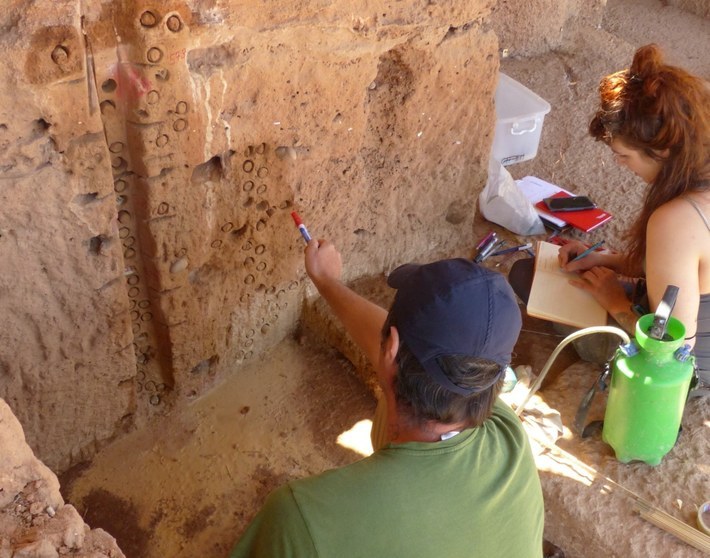
The high-resolution dating of the remains — set at approximately 773,000 years ago — was made possible by an exceptional coincidence: the fossils date to the period during which the most recent major geomagnetic pole reversal of the Earth occurred, an event known as the Matuyama–Brunhes transition.
The rapid and continuous sedimentation that took place in the Grotte à Hominidés allowed the magnetic properties of the sediments to be preserved in extraordinary detail. By analysing 180 magnetostratigraphic samples — an unprecedented level of resolution for a Pleistocene hominin site — the researchers were able to determine the exact moment of the transition from reversed polarity to the current one: 773,000 years ago, with a transitional phase lasting between 8,000 and 11,000 years.
“It is an exceptional coincidence that the sediments containing the fossils investigated were deposited precisely during this transition,” confirms Rita Sorrentino. “At a time when climatic changes periodically opened ecological corridors across what is now the Sahara, this discovery highlights the fundamental role played by north-western Africa in the earliest phase of the evolutionary history of the genus Homo.”
The study was published in Nature under the title “Early hominins from Morocco basal to the Homo sapiens lineage.” The University of Bologna was represented by Stefano Benazzi from the Department of Cultural Heritage and Rita Sorrentino from the Department of Biological, Geological and Environmental Sciences.
-

Stefano Benazzi
Stefano Benazzi is a physical anthropologist with expertise in palaeoanthropology and osteoarchaeology, and a professor at the Department of Cultural Heritage. His research focuses on the study of human remains from archaeological contexts, using scientific approaches aimed at reconstructing individuals’ biological profiles, lifestyles, and health conditions. In 2017, he founded the University of Bologna’s BONES Lab, which brings together traditional and innovative methods, including osteoarchaeological and histological analyses, advanced digital techniques and palaeoproteomics.
-

Rita Sorrentino
Rita Sorrentino is a researcher at the Department of Biological, Geological and Environmental Sciences. Her work focuses on biological anthropology and palaeoanthropology. Her research uses virtual approaches to investigate bone morphology, applying methods from geometric morphometrics and trabecular biomechanics. She is involved in national and international research projects and collaborates with scholars from a range of fields, including archaeology, palaeoanthropology, biomechanical engineering, digital radiography and computed tomography, and orthopaedics.