
“Il corpo della lingua”: ART CITY Bologna 2026’s Special Programme across venues and artworks
The University of Bologna welcomes artists whose work investigates knowledge through the body and the senses

From Thursday 5 to Sunday 8 February 2026 ART CITY Bologna, the Programme of exhibitions and events promoted by the Municipality of Bologna, with the support of BolognaFiere, on the occasion of Arte Fiera, returns for the fourteenth edition, under the artistic direction of Lorenzo Balbi, director of MAMbo - Museum of Modern Art of Bologna, part of the Civic Museums Sector of the Municipality of Bologna.
ART CITY Bologna 2026 has the Hera Group as its main sponsor.
The event is characterised by the Special Programme, curated by Caterina Molteni, which continues in the spirit of experimentation by inviting Italian and international artists to intervene in spaces not usually used for exhibition purposes, places that are forgotten or little known to the general public. Along these lines, the 2026 edition presents a special collaboration with the leading institution in the city dedicated to knowledge, dialogue and change: the Alma Mater Studiorum - Università di Bologna.
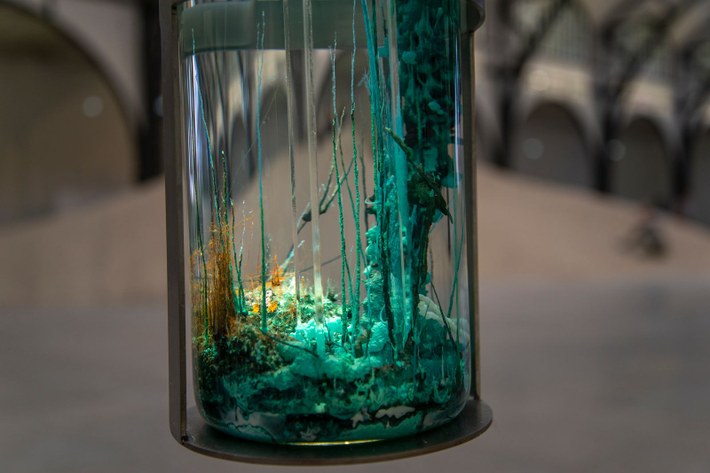
Founded on the symbolic date of 1088, the University of Bologna has always been a cultural, political and civic landmark for the city. Its history is closely intertwined with that of the city and its urban landscape, in its palaces and buildings that have hosted its activities over the centuries. Spread throughout the city – in teachers' homes, religious spaces and public buildings – during the Middle Ages and Renaissance, it found its first official home in 1563 at the Archiginnasio, before moving to Palazzo Poggi in 1803. Since then, the modern university has gradually expanded its presence, building the university citadel and helping to transform the face of the city. The Special Programme of ART CITY Bologna 2026 pays tribute to this cultural heritage with an itinerary of contemporary art that winds through the spaces of this prestigious institution, some of which will be open to the public for the occasion: the Alessandro Ghigi Hall of the former Institute of Zoology, the Atrium of the former Faculty of Engineering, the Sala della Boschereccia in Palazzo Hercolani, the Anatomical Theatre of the Archiginnasio Municipal Library, the Federico Zeri Foundation, the Educational Laboratory of the Navile District and the Aula Magna of the Bologna University Library. The works – specifically commissioned or rearranged – establish a direct dialogue with these spaces, triggering new interpretations of the University's academic, architectural and political history.
In keeping with tradition, the venues for the Special Programme are not mere containers but narrative devices that give shape to the theme of this edition: knowledge and its transmission. In this sense, ART CITY Bologna 2026 explores training and teaching as experiences rooted in a physiological and sensitive universe, beyond their usual abstract and theoretical dimension. This is the premise behind the project's title, Il corpo della lingua (The Body of Language), inspired by Giorgio Agamben's text of the same name, in which the philosopher outlines a true anatomy of language: not a static concept, but a living body, “escaping to who knows where, but certainly away from any grammatical identity and any definitive lexicon”. For Agamben, language – like knowledge – is expressed through voice, gestures and relationships with others. Rethinking the body therefore also means rethinking knowledge and its modes of transmission.
Giulia Deval, Mike Kelley, Ana Mendieta, Alexandra Pirici, Augustas Serapinas, Jenna Sutela and Nora Turato are the artists of the 2026 edition of ART CITY Bologna who, through their work, explore knowledge starting from the physicality of learning, which can reveal power structures in educational processes and, at the same time, open up spaces for resistance and new horizons for expression. In this perspective, the works on display propose alternative models of production and transmission of knowledge, questioning the authority and linearity inherent in academic and artistic knowledge. The exhibition projects question the nature of the places of education, the implicit rules that govern them and the symbolic, social and political transformations that have marked their evolution, paying particular attention to new forms of intelligence.