Among the Ancient Rocks of the Lofoten Islands, in Search of the Secrets of Hydrogen (and Water)
A scientific expedition by the University of Bologna, part of the ERC-funded DeepSeep project, will travel to the far north of Norway to study a section of Earth’s crust over a billion years old. The goal: to investigate the origins of geological hydrogen, a possible catalyst for the emergence of life on our planet and a potential new source of clean energy
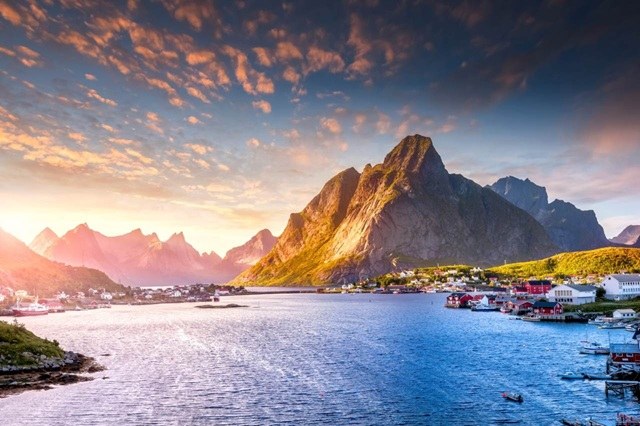
An expedition is setting out for the dramatic fjords of the Lofoten Islands, in the far north of Norway, to uncover the secrets of two elements fundamental to the evolution of life on Earth: natural hydrogen and water. The mission, based in the city of Narvik, is led by a team of geologists from the DeepCarbon Lab at the University of Bologna, in collaboration with researchers from the University of Oslo. It is part of the DeepSeep project, funded by the European Research Council (ERC).
“Our aim is to trace how hydrogen evolved on Earth, from its simplest and most energetic molecular form to its more stable combination with oxygen, which gives rise to water,” explains Alberto Vitale Brovarone, professor at the Department of Biological, Geological and Environmental Sciences at the University of Bologna and principal investigator of the DeepSeep project. “In the Lofoten Islands, we can observe these transformations in a remarkably well-preserved section of the Earth’s crust that is over a billion years old.”
Studying geological hydrogen and its evolution can open new horizons in various directions. Looking to the distant past, it may help us understand how life on Earth began. In the present, it may offer insight into how earthquakes develop. Looking ahead, it could emerge as a new source of clean energy for human use.
“The history of natural hydrogen in the Earth’s crust is still poorly understood. It involves some of the oldest rocks and minerals on the planet, including others that disappeared and later re-emerged, such as ice,” says Brovarone. “Today, we have glaciers and polar ice caps, but at various points in Earth’s history, the planet may have been completely devoid of the crystalline form of H₂O—ice.”
The DeepSeep project focuses on the deep-Earth origins of natural hydrogen and light abiotic hydrocarbons, particularly methane (CH₄), produced through interactions between deep rocks and geological fluids in the Earth’s crust. This is what distinguishes abiotic hydrocarbons from fossil hydrocarbons—like oil and coal—which are of biological origin. Evidence of natural hydrogen formation processes can be found in rare ancient crustal fragments brought to the surface by tectonic movements, including sites in Greenland, Mongolia, North America, and, notably, Norway.
The expedition will also investigate earthquakes. The team of geologists from the University of Oslo, who are partnering with the University of Bologna, studies unusual seismic activity that occurs at great depths, between 30 and 40 kilometers below the Earth’s surface. These deep earthquakes are common, for example, beneath the Himalayas, but they remain largely unexplained, as rocks at those depths are not expected to produce seismic movement. As part of the CONTINENT project, funded by the Research Council of Norway (RCN) and led by Professor Luca Menegon, the Norwegian team will study these phenomena using rocks from the Lofoten Islands, which preserve fossil evidence of ancient earthquakes that occurred billions of years ago deep within the planet.