Ancient DNA Reveals the Cosmopolitan Origin of Punic Peoples
By comparing the genome of 210 individuals from 14 Phoenician and Punic archaeological sites, it has emerged that the ancient inhabitants of Carthage had extremely heterogeneous origins, with most of their ancestry deriving from a genetic profile similar to that of modern-day Sicilian and Aegean populations, with significant contributions from North Africa
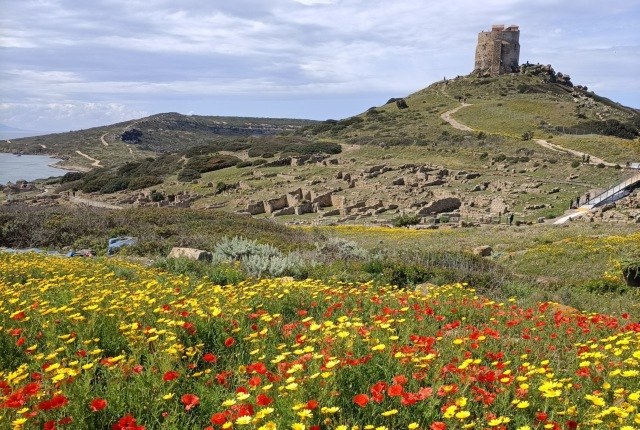
The city of Tharros seen from the current University of Bologna excavations (photo A.C. Fariselli)
The genetic links between the Phoenicians of the Levant region and the Punic populations of the central and western Mediterranean were more limited than previously believed. This is the outcome of a study, published in Nature, carried out by a research team from the University of Bologna, in collaboration with Harvard University and the Max Planck Institute. By analysing the genome of 210 individuals from 14 Phoenician and Punic archaeological sites, the researchers have revealed the cosmopolitan origin of Punic peoples.
"This survey paints a picture of the ancient Mediterranean as a dynamic space of mobility, exchange and deep integration," says Elisabetta Cilli, a molecular anthropologist at the Department of Cultural Heritage at the University of Bologna, and one of the authors of the study. "It is extraordinary to see how the Punic identity stemmed from the aggregation of a variety of populations, connected by a common culture without this necessarily being linked to biological homogeneity."
The Phoenician culture, whose earliest archaeological indicators emerge from city-states in the Levant during the Bronze Age, spread through a vast network of maritime exchanges that, from the first millennium BC, reached the coasts of Spain, North Africa, Sicily and Sardinia. In the late 9th century BC, the city of Carthage was established on the coast of present-day Tunisia. This was to become the political and economic fulcrum of the Punic civilisation, which from the second half of the 8th century BC saw an intense autonomous irradiation into the central Mediterranean. Despite the deep connection and cultural continuity between Phoenicians and Punic people, the new palaeogenomic data tells a much more complex and articulated story.
Indeed, the results of the genetic study of the remains of Phoenician and Punic individuals show that Punic populations were extremely heterogeneous from a genetic point of view, with most of their ancestry deriving from a genetic profile similar to that of modern-day Sicilian and Aegean populations, with significant contributions from North Africa.
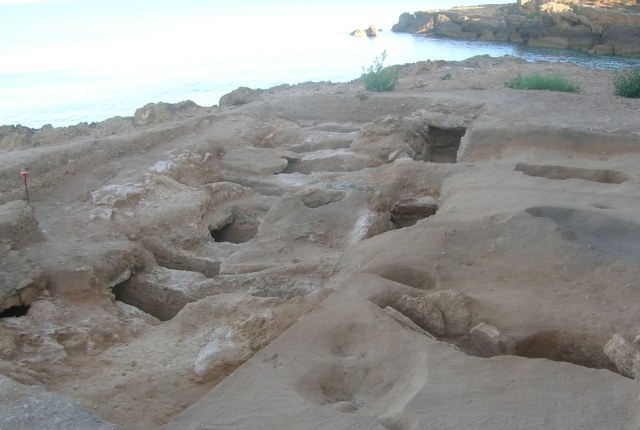
"An analysis of the remains from the necropolis of Tharros, the 'Sardinian Carthage', confirms the cosmopolitan character of the population, especially in the period between the 4th and 3rd centuries BC," explains Anna Chiara Fariselli, professor at the Department of Cultural Heritage, and one of the authors of the study. "In particular, investigations on the osteological remains of late Punic tombs in the northern necropolis of San Giovanni di Sinis, discovered by the University of Bologna in collaboration with the University of Cagliari, the concessionaire of the excavation project, show a majority of African genomic ancestry, which is consistent with the Carthaginian roots of the Punic colony, founded in the 7th century BC."
The University of Bologna excavations carried out in the necropolis of San Giovanni in collaboration with the University of Cagliari (photo A.C. Fariselli)
These findings disprove the hypothesis of a mass migration of Levantine populations. To the contrary, they suggest intense cultural transmission and local assimilation for Punic peoples.
"The analyses carried out have revealed the presence of distant relatives, such as a case of second cousins, one buried in North Africa and one in Sicily, demonstrating that family ties crossed the sea," confirms Professor Donata Luiselli, head of the Ancient DNA Laboratory at the University of Bologna, who is one of the authors of the study. "This data shows that inter-regional contacts in the ancient Mediterranean were much more intense and widespread than had been reconstructed so far."
In light of these findings, the researchers emphasise the fundamental role of ancient DNA analysis technologies in revolutionising the way we tell the story of our past.
"These technologies enable us to gain a key perspective, complementing and enriching our understanding of ancient societies," says Davide Pettener, professor at the Department of Biological, Geological and Environmental Sciences at the University of Bologna, who is one of the authors of the study. "With a well-established international collaboration between molecular geneticists and archaeologists, it is possible to clarify and learn more about the genomic history of the ancient migrations of Mediterranean peoples."
The study was published in Nature with the title "Punic people were genetically diverse with almost no Levantine ancestors". The University of Bologna was represented by Elisabetta Cilli, Anna Chiara Fariselli, Francesco Fontani and Donata Luiselli from the Department of Cultural Heritage, together with Davide Pettener from the Department of Biological, Geological and Environmental Sciences.