Climate Change and Population: the Best Projects from the “Data4Resilience” Data Challenge Awarded
A challenge for students at the University of Bologna to explore the impact of climate change on the population of Emilia-Romagna
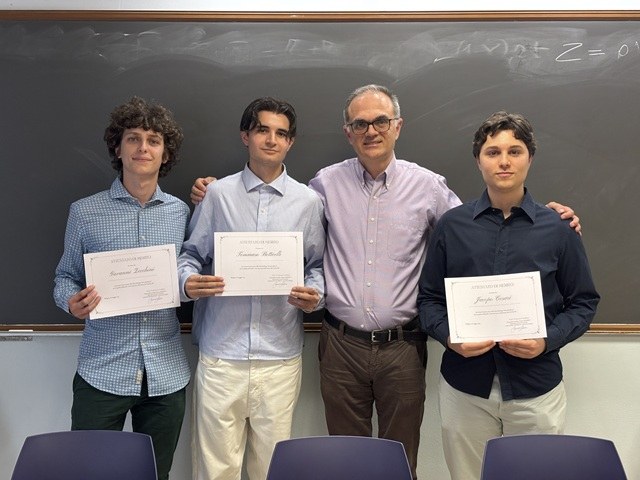
The winning team with Professor Francesco Scalone
The awards ceremony for the Data Challenge “Data4Resilience” took place at the Department of Statistical Sciences of the University of Bologna, during the event Resilience and Demographic Fragility. The competition, held as part of the MEMOREC project – Resilience and Climate Memory in Emilia-Romagna – engaged Bachelor’s and Master’s students in an applied research exercise on the demographic impact of climate change in the region.
The challenge offered an opportunity to experiment with the beta version of the EcoPop-ER database – an open-access resource integrating more than 5.5 million observations on climate, demographic and territorial indicators – while actively involving the student community in crucial topics such as the demographic and social effects of climate change.
Using maps, infographics, statistical analysis and data storytelling techniques, participants presented original reflections on depopulation, ageing, social vulnerability, and the transformation of mountain and hill areas in response to climate stress. A concrete example of how data science can provide effective tools for understanding current and future demographic and social challenges.
The first, second and third place teams
First prize was awarded to the team of Tommaso Botticelli, Jacopo Cesari and Giovanni Zecchini (Master’s Degree in Statistics, Economics and Business), for their project Climate Change and Demographic Vulnerability: an analysis of municipalities in Emilia-Romagna, which examined the relationship between environmental and demographic variables to identify the region’s most exposed and fragile areas.
Joint second place went to: Andrea D’Angeli and Matteo Panzera (Bachelor’s Degree in Statistical Sciences), for Heatwaves and vulnerable populations, a mapping of thermal risk for the over-65s and for children; Giacomo Marini and Andrea Bianco (Master’s Degree in Statistical Sciences), for Climate, Fragility and Slow Tourism, a study of the impact of climate change along the Via degli Dei and the Via dei Brentatori, with reflections on the future of sustainable tourism.
Third prize went to Hong Ngoc Trinh (Bachelor’s Degree in Statistical Sciences), for Extreme Events and Climate Vulnerability, a time-series analysis of extreme weather events in Emilia-Romagna from 2011 to 2023, including indicators of territorial vulnerability.
Special mentions were awarded to Felipe Casadei, Giulia Cevoli, Nicola Doveri, Mirko Draghi, Luca Fabbricatore, Giada Ragazzini, Leonardo Stringa and Vito Martino.
The MEMOREC project, funded through Alma CaRes by the University of Bologna, brings together an interdisciplinary team of researchers from different Departments. The project integrates demographic, climate and geographic data to provide an open-access knowledge base on the impact of climate change across the territories of Emilia-Romagna.