LOFAR Reveals Mysterious Radio Filaments in a Distant Galaxy Cluster
The deepest observations ever made of a galaxy cluster using low-frequency radio techniques have shed new light on the life cycle of radio galaxies, from their formation to their fading
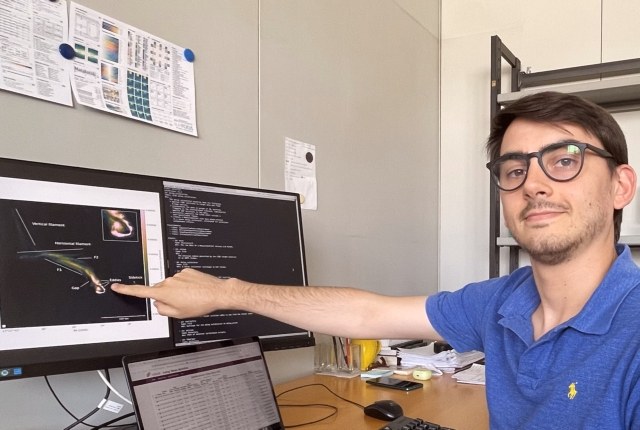
Emanuele De Rubeis, PhD candidate at the Department of Physics and Astronomy “Augusto Righi” at the University of Bologna and INAF, lead author of the study (Image: INAF)
An international team of astrophysicists, including researchers from the University of Bologna and Italy’s National Institute for Astrophysics (INAF), has produced the most detailed and deepest image to date of the galaxy cluster Abell 2255, located around 800 million light-years from Earth. The cluster is known for its complex radio structures spanning multiple scales.
The study, published inAstronomy & Astrophysics offers an unprecedented view of the cluster’s main radio galaxies — vast jets of charged particles launched at nearly the speed of light by supermassive black holes. Among the key findings is a previously unseen network of thin filaments emitting non-thermal radiation, whose origin remains unknown.
Published in Astronomy & Astrophysics, the study offers an unprecedented view of the cluster’s main radio galaxies — vast jets of charged particles launched at nearly the speed of light by supermassive black holes. Among the key findings is a previously unseen network of thin filaments emitting non-thermal radiation, whose origin remains unknown. The result is the deepest VLBI observations ever conducted on a galaxy cluster, allowing researchers to trace the evolutionary history of radio galaxies, from their active beginnings to their quiet endings. "This opens up entirely new possibilities for studying how these galaxies evolve, and how they interact with the turbulent intergalactic medium in dynamic environments like Abell 2255," says Emanuele De Rubeis, PhD candidate at the Department of Physics and Astronomy “Augusto Righi” at the University of Bologna and INAF, and lead author of the study.
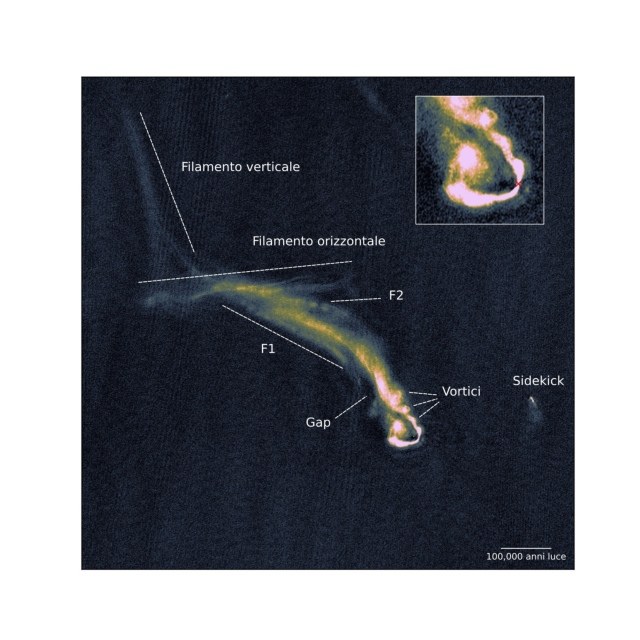
Thanks to 56 hours of continuous observation at 144 MHz, the team produced deep images with angular resolution down to 0.3 arcseconds — an exceptional combination of depth and sharpness at this frequency, made possible by long exposure times and advanced interferometric techniques. This allowed them to detect extremely elongated filamentary structures, stretching between 260,000 and 360,000 light-years — roughly three to four times the diameter of the Milky Way — but with widths over ten times thinner. According to the researchers, these filaments may originate within the radio galaxies themselves and be drawn out by turbulent flows, eventually mixing with the surrounding medium.
L'emissione radio della Original Tailed Radio Galaxy, osservata alla frequenza 144 MHz con una risoluzione angolare di 0,34 × 0,24 arcosecondi, mostra una struttura complessa e ricca di filamenti. One focus of the study was the Original Tailed Radio Galaxy, a radio galaxy with a complex, filament-filled tail that had never before been imaged with such precision. E. De Rubeis - Università di Bologna - INAF - et al. / A&A 2025)
Observed at 144 MHz with a resolution of 0.34 × 0.24 arcseconds, it revealed an intricate internal structure. An enlarged view of the host galaxy’s core — marked with a red cross — is shown in the top-right corner of the image. The study also uncovered new structural details in other notable radio galaxies within the cluster — nicknamed Goldfish, Beaver, and Embryo — all featuring distorted shapes and radio tails extending over 200,000 light-years.
“Our main goal was to use LOFAR-VLBI to search for filaments within the radio tails of Abell 2255’s galaxies, to understand their morphology and how they form,” explains Emanuele De Rubeis, first author of the study. “Phenomena like these are becoming increasingly visible thanks to modern interferometers, including the precursors to the Square Kilometre Array (SKA). They offer powerful new ways to investigate the magnetic properties of hot gas in clusters and the mechanisms of particle acceleration.”
De Rubeis adds: “We processed 56 hours of observations, divided into overnight sessions of about 8 hours each. The raw data from each night weighed in at around 4 terabytes, but after calibration that number rose to 18–20 terabytes, totalling roughly 140 terabytes.” That’s an enormous data load for a single field of view — one of the largest to date for this kind of observation, and comparable to what's expected in upcoming SKA projects. “Of course, getting quality images from these data took many attempts. On average, it took us about a month to fully process a single night’s data and produce images of all sources.”
“These findings open exciting new avenues not only for the study of radio galaxies, but also for investigating the physical properties of the intra-cluster medium — the hot gas that fills the space between galaxies in clusters,” concludes Marco Bondi, senior researcher at INAF in Bologna and second author of the study.