The University of Bologna and Conquistando Escalones Together Against a Rare Muscular Dystrophy
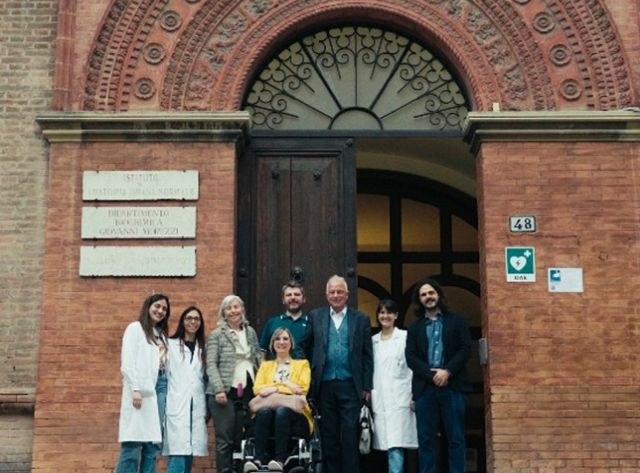
Scientific research and the commitment to tackling rare diseases have brought the University of Bologna together with Conquistando Escalones. To mark its 10th anniversary, the association visited the Anatomical Center and the Scientific Laboratories of the Department of Biomedical and Neuromotor Sciences, where research into the condition is being carried out by the University
From the search for a cure for Limb-Girdle Muscular Dystrophy type 1F/D2 (LGMD1F/D2) to a potential therapy for AIDS: the University of Bologna stands alongside the association Conquistando Escalones, founded in 2015 by members of an Italian-Spanish family affected by this rare form of muscular dystrophy, reaffirming its commitment to the fight against rare diseases and underscoring the value of collaboration between academia and patient associations.
The strengthening of a broad multidisciplinary network, which allows the disease to be tackled from multiple angles, has been made possible thanks to the support of Conquistando Escalones. To mark its 10th anniversary, the association visited the spaces of the Anatomical Center and the scientific laboratories of the Department of Biomedical and Neuromotor Sciences – DIBINEM, where the University of Bologna’s research is being carried out.
LGMD1F/D2 is caused by a mutation in the TNPO3 gene, which compromises muscle function and leads to progressive muscular weakness. Paradoxically, this very mutation appears to prevent the HIV virus from entering cells, opening up new research avenues not only for neuromuscular diseases but also for immunology and virology.
Led by Prof. Giovanna Cenacchi from the Department of Medical and Surgical Sciences – DIMEC, the University of Bologna team has played a crucial role in the morphological and ultrastructural characterization of LGMD1F/D2.
Research developments have also involved the Anatomy Center, directed by Prof. Lucia Manzoli, and the Signal Transduction Laboratory, coordinated by Prof. Stefano Ratti, both part of DIBINEM. The focus has been on understanding the pathogenetic mechanism linking the TNPO3 mutation to the clinical symptoms observed in muscle tissue.
“Our work focuses on identifying the cellular and subcellular alterations induced by the TNPO3 mutation, which impair the functionality of muscle tissue,” explains Prof. Cenacchi. “Moreover, thanks to collaborations with Prof. Focarete from the Giacomo Ciamician Department of Chemistry and Prof. Frabetti from DIMEC, we’ve developed both 3D cellular and animal models, which enable us to study the pathogenesis of the disease and identify targets to test the effectiveness of potential drugs.”
Raising funds for gene therapy, clinical trials, and the identification of already available pharmacological treatments is also the goal of the campaign “10 years, 10 steps”, launched by the association on the tenth anniversary of its founding.