Parental burnout: findings and new perspectives from the “Focus on Parents” project
The research, coordinated by Professors Federica Andrei and Elena Trombini of the University of Bologna’s Department of Psychology “Renzo Canestrari”, examines parental wellbeing and the factors influencing burnout in Italian families

The research project “Focus on parents: antecedents, trajectories and role differences in parental burnout”, funded by the European Union – NextGenerationEU under the PNRR framework and coordinated by Professors Federica Andrei and Elena Trombini of the University of Bologna’s Department of Psychology “Renzo Canestrari”, has now concluded.
The two-year project involved three samples drawn from the Italian parent population, with children aged 0 to 18, recruited through schools, mental health services, and the NINFEA study cohort. At the heart of the study is parental burnout (PB), a clinical syndrome distinct from parenting stress and occupational burnout, characterised by emotional and physical exhaustion linked to the parental role, emotional detachment from one's children, loss of satisfaction in the role, and a conflicted sense of oneself as a parent.
The project's main goals were: to examine the psychometric validity of the Italian version of the Parental Burnout Assessment (PBA); to generate original epidemiological data on parental burnout in the Italian context (covering prevalence, risk and protective factors, and trends over time); and to investigate the characteristics of PB in specific at-risk populations, such as parents with psychopathological conditions.
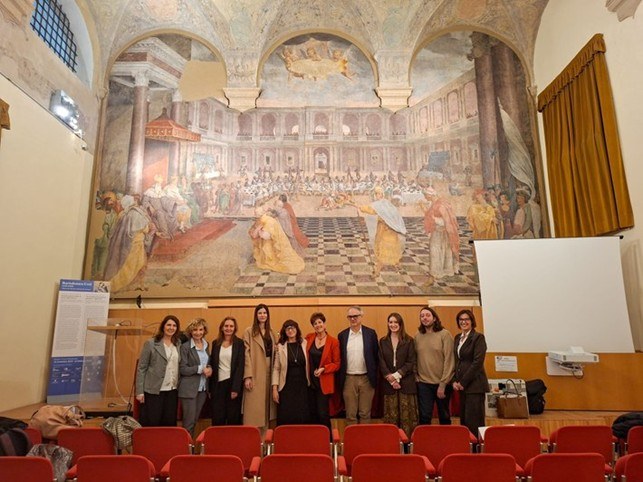
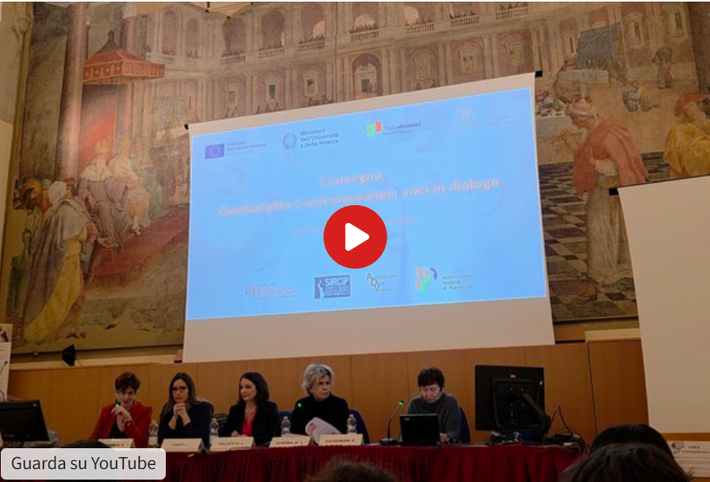
The findings were presented at the conference “Genitorialità contemporanee: voci in dialogo”, organised by Professors Federica Andrei and Elena Trombini, which brought together researchers from four universities (Bologna, Palermo, Rome La Sapienza, and Turin) alongside clinicians, education specialists, paediatricians, child and adolescent neuropsychiatrists, midwives and youth workers, fostering an interdisciplinary dialogue on parenthood, parental burnout, and models of family support.
The conference opened with welcome addresses by Maria Letizia Guerra (the Rector's delegate for public engagement), Elvira Cicognani (Head of the Department of Psychology “Renzo Canestrari”), Isabella Conti (Regional Councillor for Welfare and Policies for Children and Schools for the region of Emilia-Romagna) and Luana Valletta (President of the Emilia-Romagna Board of Psychologists).
The morning session continued with presentations by Elena Trombini and Veronica Della Casa (Department of Psychology “Renzo Canestrari”, University of Bologna), who illustrated the project's findings across various regions, showing that PB can occur in the absence of socio-economic hardship, while internal factors such as perfectionism and mental load play a determining role. The research also identified a consistent gap between mothers and fathers — with higher levels recorded among mothers — and a tendency for the condition to remain stable over time in the absence of intervention.
Maria Stella Epifanio and Marco Andrea Piombo (University of Palermo) then examined paternal burnout, characterising it as a complex relational phenomenon in which both the partner's role and the regulatory function of co-parenting prove significant.
Maja Popovic (University of Turin) presented data from the NINFEA study cohort on the early origins of burnout in mothers, showing that patterns of vulnerability linked to sociodemographic factors, maternal characteristics, and the quality of mother-child interaction emerge as early as the first one thousand days of life.
The round table that followed brought together a range of professional perspectives, with contributions from: Francesca Agostini (psychologist, psychotherapist, and Professor of Dynamic Psychology at the Department of Psychology “Renzo Canestrari”), who addressed the importance of an integrated understanding of intrapsychic, neurobiological, developmental and social processes, and the early identification of high-risk situations; Lucia Balduzzi (Professor of Didactics and Special Pedagogy at the Department of Education Studies “Giovanni Maria Bertin”), who presented the “Poli Millegiorni” network, a national system of integrated early years education centres for children aged 0–6; Marina Govoni and Michele Torella (community paediatricians, ASL Bologna), who highlighted the paediatrician's frontline role in the early recognition of PB; Simona Bertozzini (Educational psychologist and Head of the Educational Activities and Pedagogical Coordination Unit, Municipality of Pesaro), who outlined psycho-educational strategies for supporting parents within early years services; and Alessandra Bellasio (midwife, Head of Continuing Medical Education at UniMamma – MediaDream Academy, President of UMAP – a social promotion association for parenting support, and founder of the BestBirth.it project), who contributed a midwife’s perspective, emphasising the value of continuous support from pregnancy onwards.
The closing session widened the lens on parenthood to encompass the full arc of human development. Giorgio Rossi (neuropsychiatrist, psychotherapist, former Head of the Complex Neuopsychiatry Unit in Varese, and Visiting Professor at the Faculty of Psychology at the Università Cattolica, Brescia) addressed the specific demands of parenting adolescents, examining the relational strains and identity disorientation that characterise this stage of life.
Leonardo De Pascalis (psychologist, Professor of Dynamic Psychology at the Department of Psychology “Renzo Canestrari”, University of Bologna, and at the Department of Psychology, Institute of Population Health, University of Liverpool) then presented Dialogic Reading as a practice for fostering child development and an indirect means of supporting parents.
Finally, Barbara Giorgi and Cristina Nanetti (psychologists, psychotherapists, and psychoanalysts at the Bologna Psychoanalytic Centre) offered a psychoanalytic perspective on the transformations of contemporary parenthood, drawing on the work of the “Essere Genitori” and “Il Faro” groups — spaces devoted to the psychological working-through of family legacies and social change.