
The Landfill and the Black Soldier Fly
Home to thousands of “waste pickers”, Dandora is the largest open-air landfill in East Africa. Here, the University of Bologna works alongside local community organisations to develop innovative projects in sustainable urban agriculture – with the help of a small insect...

"The aim is to create a fully circular recovery system. Organic waste feeds the black soldier fly larvae, which become low-cost protein feed for livestock. The same organic waste, once used for larval growth, is converted into compost suitable for urban agriculture"
A small fly, through its tireless activity, is helping to improve food security for residents of one of Nairobi’s most deprived and challenging areas. We are in Dandora, the largest open-air landfill in East Africa: a vast mountain of waste covering more than 12 hectares on the eastern outskirts of the Kenyan capital. Every day, thousands of people struggle to survive by scavenging through discarded materials in search of items they can recover, recycle and sell.
These “waste pickers” live in large informal settlements on the edges of the landfill – precarious and hazardous environments without sewage systems, roads or basic services, and with no adequate spaces or facilities for food production.
Yet in one of these settlements, new projects are beginning to take shape: a tank for aquaculture, a unit for pig rearing, and a space for growing vegetables. All of these initiatives revolve around a small insect: the black soldier fly.
“Rearing black soldier flies is a very low-cost way of obtaining a rich source of protein for both livestock farming and aquaculture. The larvae of this insect are highly nutritious feed, and at the same time the organic waste they consume is transformed into compost suitable for growing vegetables,” explains Francesco Orsini, professor in the Department of Agricultural and Food Sciences at the University of Bologna, who has been working in Kenya and the Nairobi area for several years on sustainable urban agriculture projects.
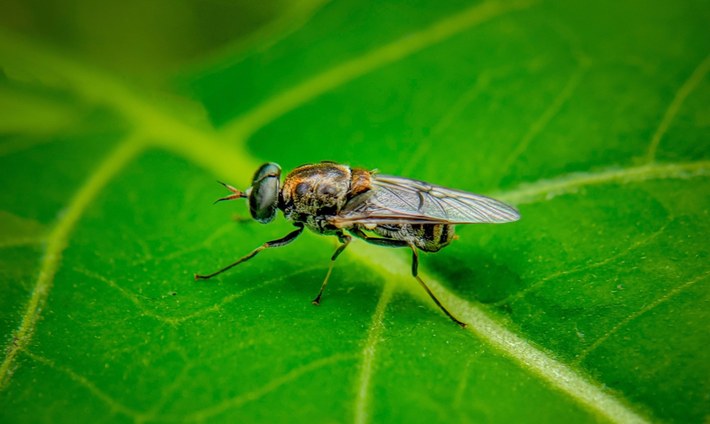
The idea of introducing black soldier fly rearing in Dandora emerged a year ago from a group of students from the University of Bologna and other universities, brought together by Professor Orsini and Professor Danila Longo of the Department of Architecture.
The University of Bologna students took part in an international workshop organised by Growth4Change, a network connecting community-based organisations active in the Dandora area. More than 150 participants from 39 countries attended, all sharing a common goal: to develop urban agriculture projects aimed at improving food security in informal settlements on the outskirts of Nairobi.
On that occasion, the University of Bologna group began collaborating with the Lucky Summer Environmental and Waste Organization (LEWMO), a community organization operating in the Lucky Summer informal settlement on the southern side of Dandora, where it develops circular waste management solutions. It was through this collaboration that the proposal to introduce black soldier fly farming was born.
The University of Bologna students then developed the project, which included a greenhouse for rearing the larvae and an adjacent unit for pig farming. The next step was to raise funds to build the facilities – and LEWMO’s activists wasted no time.
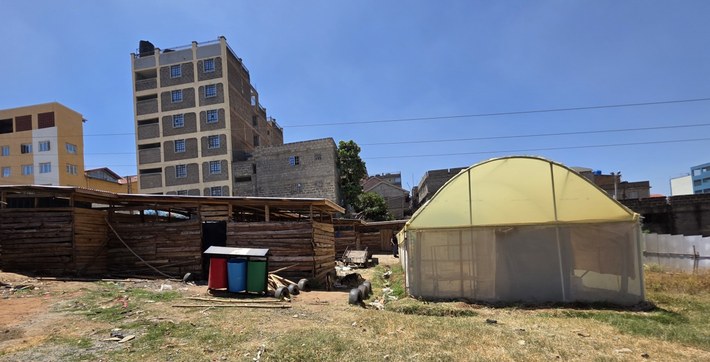
“When I returned to Nairobi at the beginning of this year, together with colleagues Giorgio Prosdocimi Gianquinto and Giuseppina Pennisi, we found the greenhouse, the pig-rearing unit and even an aquaculture tank already in place: they had not only secured the necessary funding, but had also completed construction,” says Orsini. “They are now planning to create a vegetable garden using the soil improver derived from the organic waste on which the black soldier flies grow.”
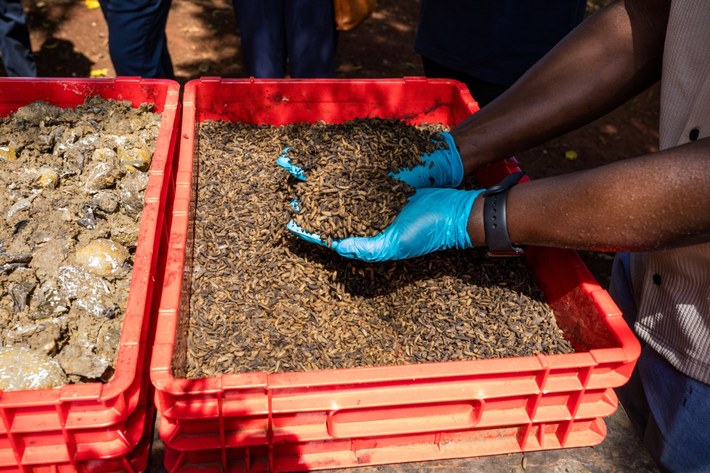
While materials such as metal, plastic, and glass can be recovered by Dandora’s waste pickers, the landfill’s organic waste typically goes unused, partly because it cannot be directly applied as fertiliser. For black soldier fly larvae, however, it provides an ideal feeding substrate. Moreover, during their growth process, these insects secrete substances capable of suppressing pathogenic bacteria. In this way, organic waste from the landfill is effectively “cleaned” and transformed into a more stable soil improver suitable for vegetable cultivation.
“The aim is to create a fully circular recovery system,” Orsini confirms. “Organic waste feeds the black soldier fly larvae, which become low-cost protein feed for livestock. The same organic waste, once used for larval growth, is converted into compost suitable for urban agriculture.”
The success of the project has also helped strengthen the network of relationships between the University of Bologna and students, researchers and activists working in the Dandora area. One of them is Victor Charo Otieno, a student at the University of Nairobi who has recently completed a research and training period at the University of Bologna.
“My three months in Bologna were extremely productive: I had the opportunity to engage with other students and collaborate with professors, PhD candidates and young researchers,” he explains. “The activities in the vertical farm and greenhouses at the Department of Agricultural and Food Sciences provided valuable insights for both my research and the projects we are developing in Nairobi.”
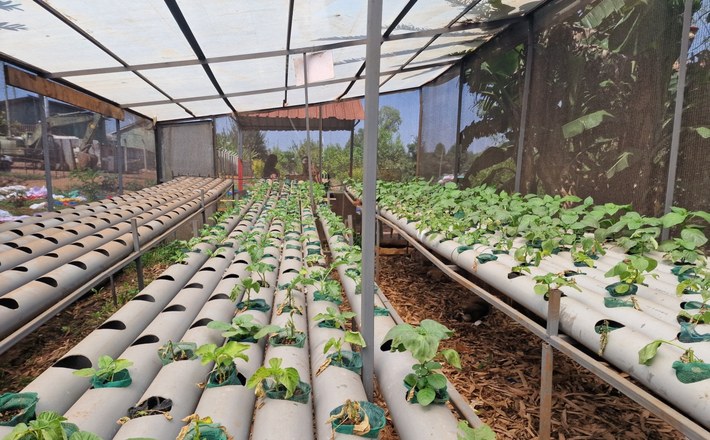
Victor Charo is also among the founders of Chamie Organics, an organisation that develops simplified hydroponic systems to improve food production and water resource management in the Dandora area. “In our context, space is limited and access to good-quality soil is scarce,” he says. “That is why we have focused on growing vegetables in vertical hydroponic systems and on aquaculture, alongside black soldier fly farming.”
The idea took shape during the pandemic, when conditions in the informal settlements around Dandora became particularly difficult. “Lockdown periods made access to food even more challenging for people living in that area,” Victor Charo confirms. “At the time, we had worked on a small university project on hydroponic cultivation, so we decided to develop a low-cost, efficient solution that could be applied in that context.”
Today, Chamie Organics continues to develop new initiatives and, like the Lucky Summer Environmental and Waste Organization (LEWMO), is part of the Growth4Change network.
Meanwhile, the commitment of University of Bologna students continues. Just a couple of weeks ago, around 150 students took part in a new workshop aimed at developing ideas to be implemented in the Dandora area. This time, two lecturers from the Jomo Kenyatta University of Agriculture and Technology in Nairobi – John Wesonga and Annah Indeche – were also visiting the University of Bologna. “The goal remains to identify effective solutions to strengthen food security and food sovereignty for people living in informal settlements,” says Professor Orsini. “Last year’s work delivered excellent results, and our efforts are now continuing along the same path.”