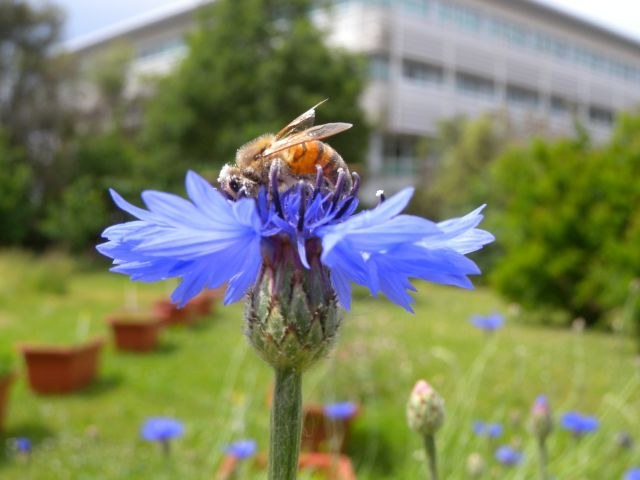
Wildflowers: a Pearl of Biodiversity Blooms at the University of Bologna
Colourful flowers, grown in an area of the green space surrounding the Department of Agricultural and Food Sciences, symbolise the importance of safeguarding the variety of life on our Planet, for the wellbeing of ecosystems and the community
Over the past few days, a collection of seeds of now rare species, from areas still under traditional agronomic management, has given life to a colourful strip of flowers in an area of the green space surrounding the Department of Agricultural and Food Sciences of the University of Bologna.
These flower strips symbolise how important it is to boost biodiversity. Today, agroecosystems, even more than natural ecosystems, are increasingly lacking in both flora and fauna biodiversity.
Entomogamous plant species, which rely on insects for pollination, are in decline due to a particularly difficult ‘anthropocene’ – in survival terms – for those species that coevolve in mutualistic relationships.
Herbaceous rotations are unfortunately increasingly lacking in those fodder crops, especially fabaceous plants, that were once a fundamental resource of pollen and nectar, both for bees and for the further biodiversity of pollinators.
The flower landscapes that inspired many painters from centuries past are now a rarity confined to agro-ecological oases in hilly and/or mountainous areas, where ancient agronomic practices and the associated phytocoenoses of wild flowers have survived.
The purpose of such flora, sown alongside extensive cultivation, is manifold: on the one hand it increases the biodiversity of pollinators, while on the other it enhances the rural landscape and creates the prerequisites for agricultural sustainability based on the survival of natural enemies of biotic adversities.
Setting up ‘flower gardens’ of spontaneous species in the city also promotes the psychological well-being of human beings: ‘miniature’ rural landscapes that have disappeared in urban areas can arouse biophilia, particularly in those – still in the developmental phase – who need to be ‘imprinted’ with a knowledge of nature, its rules and a sense of belonging to the living biosphere.