
Food delivery in Italy: global platforms versus local alternatives
Led by the University of Bologna, the BUMOLDS research project has investigated consumer and restaurant owner preferences and challenges within home delivery services, proposing a new, community-focused alternative
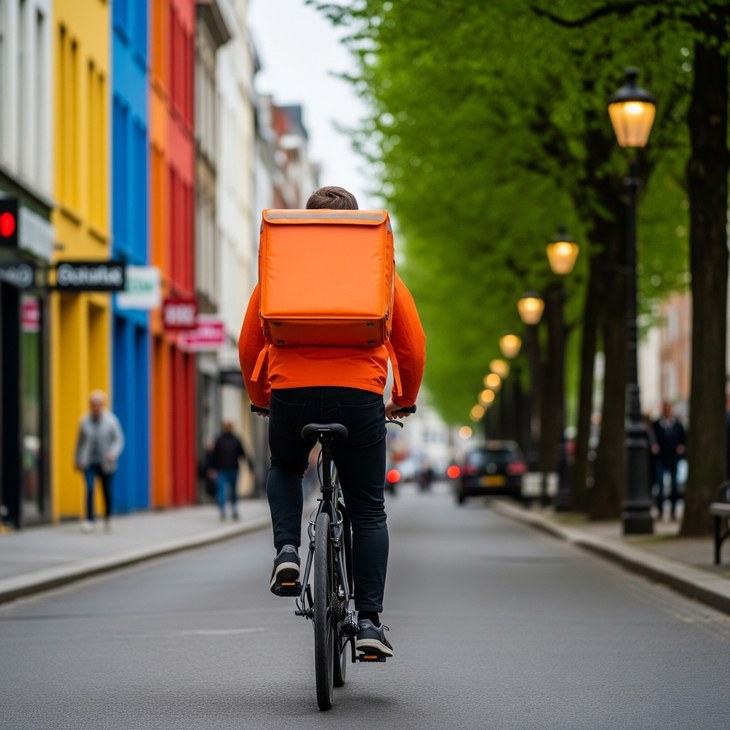
Those who use food delivery services are often aware of the issues surrounding the delivery workers’ working conditions, environmental impact, and the depletion of local economies. However, these values rarely translate into concrete action when they conflict with the convenience, speed, and reliability offered by global platforms.
An alternative does exist: local delivery platforms. Yet, their development depends on economic conditions that are often difficult to achieve, such as sustainable commission fee levels, operational reliability, and the ability to generate sufficient order volumes.
The BUMOLDS (Business Model for Local Delivery Platforms)project examines this landscape. A PRIN (Research Project of National Interest) initiative funded by the PNRR, the project is led by the University of Bologna’s Department of Management. The findings will be presented on 26 February, alongside international experts and partners from the University of Bergamo, the University of Pisa, and the Università Cattolica del Sacro Cuore in Milan.
“The use of food delivery services is primarily driven by ‘situational’ consumption; people turn to these platforms when they are tired, short on time, or craving something specific,” explains Annamaria Tuan, Professor at the Department of Management and project coordinator. “In this context, local delivery platforms are not a simple or automatic solution. However, they provide scope for experimentation to rethink the relationship between technology, the market, and the local area in a more inclusive and sustainable way.”
A survey of 1,946 Italian consumers reveals that food delivery is now widespread, with 41.1% reporting the use of delivery platforms. However, the overall economic impact of these services remains limited, accounting for approximately 1.5% of total food expenditure. The primary reasons for using delivery platforms are convenience (27.2%), a desire for treats or specific dishes (17.2%), and a lack of time (14.1%). When selecting a delivery service, the most significant factors are food quality (4.4 out of 5) and clarity regarding timing and costs (4.3 out of 5). In contrast, sustainability-related issues carry less weight in actual decision-making (3.6 out of 5).
“Major food delivery platforms have established themselves through operational efficiency, broad geographical coverage, and the standardisation of the user experience,” says Tuan. “However, these advantages are accompanied by increasingly evident structural challenges, as highlighted by recent judicial inquiries into the sector. These include controversial working conditions, significant environmental impact, power imbalances affecting restaurant owners, and a progressive drain on local value.”
The 265 restaurant owners involved in the survey confirm this view. An underlying conflict is evident: while global platforms are recognised as necessary to reach customers, they are associated with numerous issues. These include high commission fees, loss of control over relationships with customers, and visibility governed by opaque algorithms.
The BUMOLDS project was launched to seek an alternative to this scenario and create a prototype for a local delivery platform capable of creating value by leveraging local resources. This has led to the development of the BUMOLDS Business Model Framework, which integrates economic efficiency, social responsibility, and local value.
“The case studies we analysed demonstrate that while local delivery platforms serve as vital hubs for innovation, they remain hampered by scale constraints, high logistical costs, and intense competitive pressure,” Tuan explains. “Their long-term viability therefore depends on the ability to translate the values of proximity and fairness into economically resilient models, supported by appropriate public policies and shifting consumer preferences."
BUMOLDS has also produced the first national mapping of local delivery platforms. The two-year study identified 40 active organisations across Italy — with cases in Bolzano, Bologna, Turin and Corigliano — with services ranging from prepared meal delivery to local grocery shopping. Their operational reach varies from individual municipalities and provinces to entire macro-regions.
The data collected and the project’s outcomes will be presented on Thursday, 26 February, at the BUMOLDS closing event. The session begins at 11 am at the University of Bologna’s Department of Management (Via Capo di Lucca, 34 - Bologna).
Annamaria Tuan
-

Annamaria Tuan
Annamaria Tuan is Associate Professor of Marketing at the Department of Management. Her research focuses primarily on Social Media Marketing and Corporate Social Responsibility communication, employing both manual and automated content analysis techniques. She is a member of the core faculty at the Bologna Business School, where she teaches courses in Digital Marketing.