
Sinbiosys and Bacman-HERO: How Innovative Ventures and New Opportunities Take Shape
Two examples from the University of Bologna’s entrepreneurial ecosystem, which today includes 62 accredited companies spanning spin-offs and student startups

"It is a system in which the University, businesses, institutions and research centres work together to build a connected and enabling environment – one that can transform expertise and technologies into new initiatives"
An insight, a need, a question someone chooses to answer. This is often how the most compelling journeys begin – growing over time into ventures capable of generating real impact. The stories of Sinbiosys, a spin-off of the University of Bologna, and the Bacman-HERO team, a student-led entrepreneurial initiative born within the University, show how two very different ideas can take root and evolve into something greater.
Sinbiosys Srl began within the Department of Chemistry “Giacomo Ciamician”. Here, the research group led by Professor Paola Ceroni – long engaged in the study of photoactive molecules and luminescent materials – has developed its work step by step, supported by both international and internal collaborations within the University.
In this fertile environment, the synthesis of silicon nanocrystals for energy conversion took shape, together with the realisation that these innovative materials could have practical applications beyond the laboratory.
In June 2020, this insight became a business venture with the creation of the Sinbiosys spin-off, focused on developing sustainable nanomaterials for use as optical sensors and probes, technologies for energy conversion, and solutions for plastic recycling. Over time, the company has steered its technology towards plastic traceability and advanced sorting through projects such as RESTO and PRESTO, culminating in the European Women TechEU recognition, awarded to support female entrepreneurship and build on previous achievements.
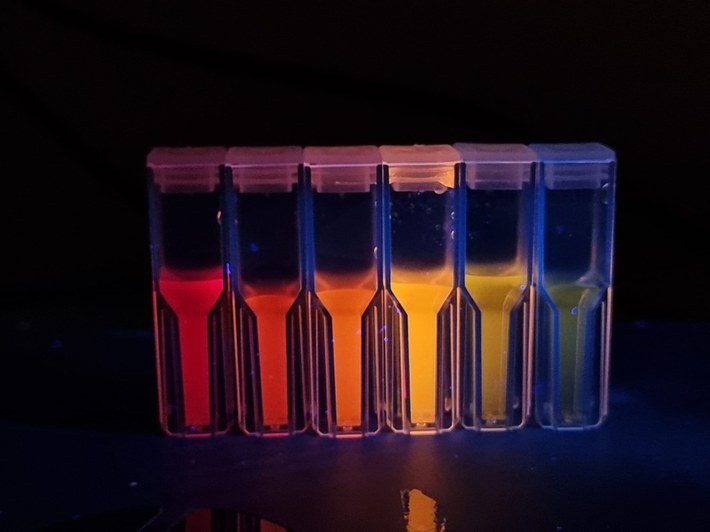
This journey has now led to the ELISET project – Emission Lifetimes Technology for Sorting, Security and Traceability – a technology that extends the use of luminescent materials to invisible coding, security and supply chain traceability. This marks a significant expansion in the practical impact of research originating in the Ciamician laboratories.
“Sinbiosys grew out of years of university research into innovative and sustainable materials. The decisive step was recognising that these results could become a useful technology – capable of moving beyond the laboratory and addressing real needs in industry and sustainability. The Women TechEU recognition and, more recently, the ELISET project confirm the strength of this growth path,” says Professor Paola Ceroni.
The story of Sinbiosys is part of an entrepreneurial ecosystem that the University of Bologna has progressively strengthened and structured. The University now counts 62 accredited companies, including spin-offs and student startups. Over the past five years, 35 new ventures have been accredited – around six each year. In 2024, the total turnover of these companies reached €26.4 million, up on the previous year, and they involve 344 people across staff and collaborators.
These figures reflect not only the vitality of the ecosystem, but also its impact on the local area. “It is a system in which the University, businesses, institutions and research centres work together to build a connected and enabling environment – one that can transform expertise and technologies into new initiatives,” explains Professor Matteo Vignoli, Delegate for Third Mission at the Department of Management.
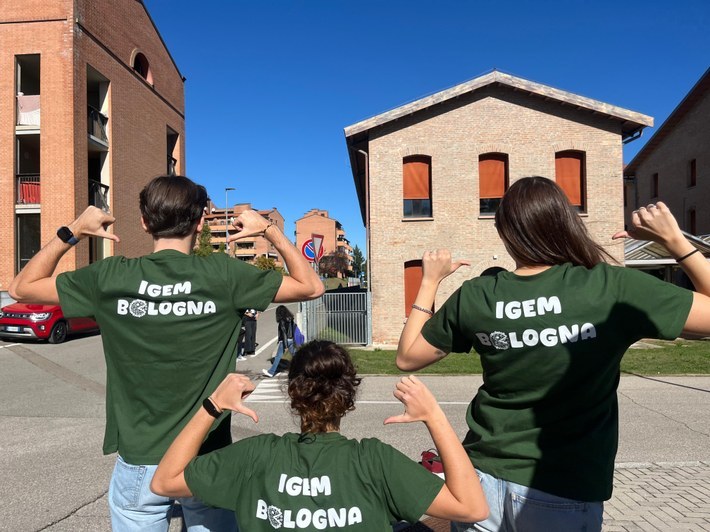
While Sinbiosys represents the outcome of long-term research, the story of the Bacman-HERO team highlights another dimension of university entrepreneurship – one driven by the curiosity and energy of students.
The project was launched by three recent graduates, all aged 22, who had just completed their degrees in Biotechnology. Their encounter with Professor Martina Cappelletti from the Department of Pharmacy and Biotechnology, an expert in environmental bioremediation, led to the creation of HERO – High Performance Engineered Rhodococcus Opacus. The project was developed for the international iGEM competition and focuses on building molecular, computational and chemical platforms to promote the use of the bacterium Rhodococcus opacus in the remediation of contaminated soils and water.
The initial idea quickly gained momentum: from three members, the team grew to five, then ten, and ultimately thirteen students. This marked the creation of the University of Bologna’s first iGEM team.
With the conclusion of the HERO project, Bacman has completed its cycle, but it has left a lasting legacy – enabling new generations of students to develop fresh ideas and projects each year through the iGEM Unibo team.
“The journey was intense and complex – involving bureaucracy, experimentation, logistical challenges and group dynamics – but it proved to be an incredibly formative experience. We have now handed over to a new cohort, a new team with a new entrepreneurial idea ready to carry forward the iGEM experience. Bacman’s ultimate goal was to give new generations the opportunity to express the creativity that we are so often encouraged to develop at school, but rarely given the chance to fully realise,” says Alice Foschi from Bacman-HERO.
The experiences of Sinbiosys and Bacman-HERO show that initiatives are more likely to grow when they build complementary teams, with clear operational roles and a distinction between scientific and entrepreneurial responsibilities. There is also a cultural dimension: the ability to combine high-quality research with a genuine entrepreneurial mindset, oriented towards the market and business models. This shift – from a purely technical approach to a business-oriented one – is often what makes the difference between a promising project and a venture capable of scaling and consolidating.
“Startups and spin-offs are among the most tangible ways in which the University engages with society. Their growth depends on the strength of the ecosystem, but also on the ability of teams to open up to the market, involve new energies – starting with students – and translate research into value,” concludes Professor Vignoli.