
Jupiter Is (Slightly) Smaller Than We Thought
New data from NASA’s Juno mission and the Hubble Space Telescope have enabled scientists to determine the planet’s shape with an uncertainty of just 0.4 kilometres: the gas giant’s radius is 8 kilometres smaller than previous estimates suggested

“These new results provide us with an additional piece of the puzzle to improve models of Jupiter’s internal composition and to gain a deeper understanding of the structure and dynamics of the Solar System’s gas giants and exoplanets”
Jupiter, the largest planet in the Solar System, is slightly smaller than previously thought. This was revealed by an international research group, including scholars from the University of Bologna, using new data from NASA’s Juno mission and the Hubble Space Telescope.
The study — published in Nature Astronomy — shows that Jupiter’s average radius is 69,886 kilometres, 8 kilometres less than previous estimates.
“The new data collected by Juno and Hubble have allowed us to build upon the valuable legacy left by previous missions, Pioneer and Voyager,” says Matteo Fonsetti, an astrophysicist and PhD student at the University of Bologna’s Department of Industrial Engineering, and one of the authors of the study. “Thanks to these new results, we now have another piece of the puzzle to refine models of Jupiter’s internal composition and better understand the structure and dynamics of gas giants in our Solar System and exoplanets.”
Jupiter is by far the largest planet in the Solar System: its mass is more than twice the combined mass of all the other planets. It is also the fastest-rotating planet: a day on Jupiter lasts just under ten hours. The combined effect of this rapid rotation and its complex internal structure give the planet a larger radius at its equator compared to the poles.
The planet’s irregular shape — significantly flattened at the poles and bulging at the equator — had already emerged from observations by the Pioneer and Voyager missions in the 1970s. However, we had to wait more than forty years to update this image and define it in greater detail.
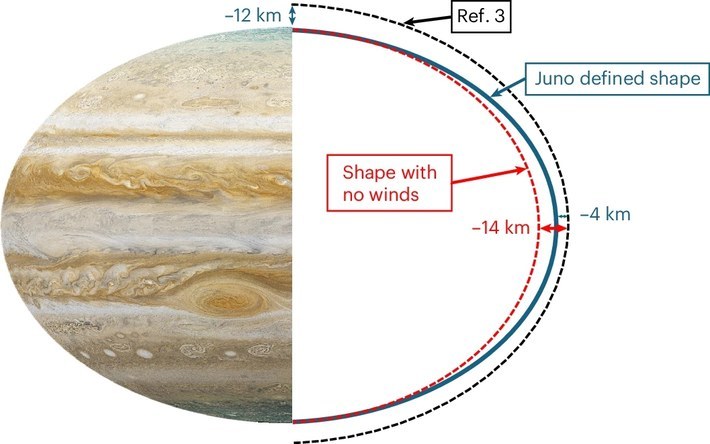
The role of the new Juno mission, in orbit around Jupiter since 2016 to study its internal structure and its complex atmosphere, was decisive. Thanks to its highly elliptical polar trajectory, which brings the probe close to the planet’s clouds, Juno has been able to obtain new high-definition temperature and pressure profiles.
“These observations allowed us to determine the planet’s shape with an uncertainty of just 0.4 kilometres,” explains Marco Zannoni, a professor at the University of Bologna’s Department of Industrial Engineering, head of the Radio Science and Planetary Exploration Laboratory, and co-author of the study. “We were thus able to increase the precision of previous analyses by an order of magnitude: it is like moving from a grainy photograph to a high-resolution CT scan.”
The new values indicate that Jupiter’s radius measured at the poles is 12 kilometres smaller than previously thought (66,886 kilometres), while at the equator it is 4 kilometres smaller (71,488 kilometres). On average, the planet’s radius is 8 kilometres smaller than previous estimates.
“This new picture of Jupiter’s shape and size has significant implications for internal models,” adds Matteo Fonsetti. “A smaller equatorial radius is compatible with a colder outer envelope richer in heavy elements, helping to reduce discrepancies between theoretical models and data collected by the Galileo and Voyager missions.”
In addition to giving us a better understanding of Jupiter’s appearance, these new measurements may prove fundamental as new standards for studying other gas giants both within and outside our Solar System.
While the Juno probe continues to gather new data, attention is already turning to the European Space Agency’s JUICE mission, which will explore new regions of Jupiter’s atmosphere and further refine our understanding of the large gas giant.
The study was published in Nature Astronomy under the title “The size and shape of Jupiter”. Contributors from the University of Bologna included Matteo Fonsetti, Andrea Caruso, Paolo Tortora, and Marco Zannoni from the Department of Industrial Engineering and CIRI Aerospace (Forlì Campus).
Marco Fonsetti
-

Marco Fonsetti
Matteo Fonsetti is an astrophysicist and PhD student at the Radio Science and Planetary Exploration Laboratory of the University of Bologna. His research focuses on studying the outer Solar System through radio science experiments. He works on the analysis of radio occultation experiments from the Juno mission and the re-analysis of historical archives from the Pioneer, Voyager, and Galileo missions. His scientific interests include planetary geodesy, with a focus on internal models of gas and ice giants, plasma physics, and stellar astrophysics.
-

Marco Zannoni
Marco Zannoni is an Associate Professor at the Department of Industrial Engineering at the University of Bologna and, since 2010, a member of the university’s Radio Science and Planetary Exploration Laboratory, which he currently leads. He has participated in radio science experiments for several interplanetary missions (Cassini, Juno, BepiColombo, Juice, Hera, Europa Clipper), working on data analysis and orbit determination for planetary geodesy applications. His research interests include orbit determination and navigation of small satellites in deep space (ArgoMoon, LICIACube).