
Vera Rubin Observatory: A New Era for Astronomy
From the first images of the sky to the survey that will scan the cosmos for ten years: the Department of Physics and Astronomy “Augusto Righi” (DIFA) is playing a key role in a telescope set to transform astronomical observation. Members of the team share the story

Researchers are part of an international community without distinctions, where skills and mutual respect are what matter. Vera Rubin carries an experience that goes beyond scientific research: a message of peace and collaboration
After the first images released in June 2025 revealed to the world the extraordinary potential of the Vera C. Rubin Observatory, home to one of the most innovative telescopes on the international scene, the project has moved into its final commissioning and testing phase.. Rubin is now preparing to launch the Legacy Survey of Space and Time (LSST): ten years of observations of the southern sky, every three nights, to create a “movie” of the evolving Universe, a dynamic, unprecedented map of the cosmos.
The project brings together thousands of researchers from 28 countries. The Department of Physics and Astronomy ‘Augusto Righi’ (DIFA) at the University of Bologna is a key contributor to the project.
Gabriele Umbriaco, Gabriele Rodeghiero, Alessio Taranto, Luca Rosignoli and Giulia Despali describe the technical challenges linked to the instrumentation and to handling an unprecedented volume of data, as well as the scientific and human growth that comes from taking part in a project of global significance.
The Vera C. Rubin Observatory
Located in the Chilean Andes, the Vera C. Rubin Observatory hosts a telescope with an 8.4-metre primary mirror and the world’s largest digital camera, LSSTCam, with over 3.2 gigapixels. The telescope has the widest field of view ever achieved by an 8-metre-class ground-based instrument and features a unique optical design: the primary and tertiary mirrors are integrated into a single block of glass, an uncommon solution in modern telescope engineering.
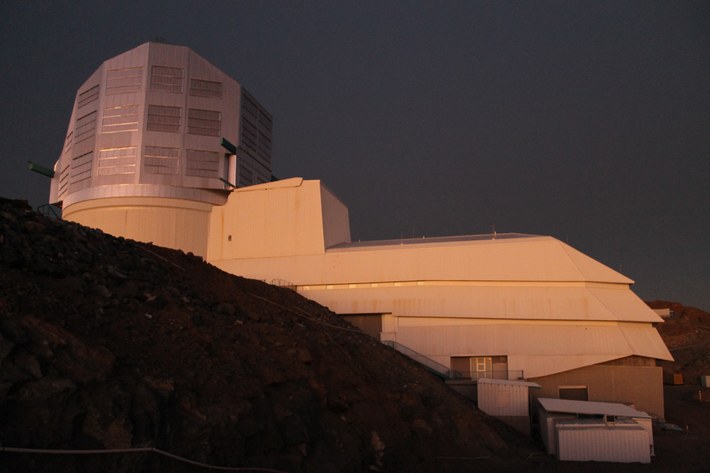
From commissioning to the Legacy Survey of Space and Time
“Last summer we unveiled the first images of the sky,” explains Gabriele Rodeghiero, head of the team at INAF – the Astrophysics and Space Science Observatory of Bologna, which collaborates with DIFA on the project; INAF researchers Enrico Giro, Rodolfo Canestrari and Felice Cusano are also involved. “At that stage we were in the commissioning phase: months dedicated to on-sky testing, optimising an extremely complex system, and addressing issues as they emerged. Rubin is now in a transition phase. The system works, but the goal is to make it operate fully autonomously—like a space telescope, even though it’s on the ground. Once LSST officially begins, the dome will open at sunset and the telescope will observe throughout the night, following a precise schedule, for ten years. The start date for the LSST has not yet been set, but it could be announced soon. A hybrid mode is being considered, where part of the night is dedicated to the survey and part to optimisation, gradually moving towards 100% scientific observations.”
The contribution of the Department of Physics and Astronomy
In the project’s initial stages, the team worked to verify the performance of the cell that houses the secondary mirror, the largest of its kind for an 8-metre-class telescope.
Work then focused on the active optics system, responsible for maintaining the telescope’s focus during night-time observations and optimising image quality. Thanks to the commissioning of the test camera, installed in October last year, detailed testing began to evaluate the system’s performance.
An “invisible” challenge: stray light
One of the most demanding technical challenges faced by the University of Bologna team is the study of stray light, unwanted light that must be understood and mitigated to ensure the scientific quality of the images.
“It’s light that doesn’t follow the nominal path the telescope was designed for,” explains Alessio Taranto, a PhD student at DIFA. “Even light coming from outside the field of view can reflect off mirrors and reach the camera, creating artefacts that have nothing to do with the sky.”
Streaks, halos and unwanted silhouettes can compromise key measurements such as photometry. “Our first step was to catalogue these artefacts,” Taranto continues, “then use optical simulations to reconstruct where they were coming from, and finally propose hardware solutions to remove them. We are now implementing these solutions and verifying their performance.
Gabriele Rodeghiero likens the work to a detective story: “You can see the trace in the image, but identifying its origin is far from straightforward. It’s a process of forming hypotheses, running simulations and carrying out checks. When you finally pinpoint the culprit, you move the entire project forward.”
Today, in this advanced stage of commissioning, DIFA’s contribution is focused on bringing the telescope to the performance needed to start LSST, from analysing artefacts in observational data, to tracing their causes, to designing, installing and testing hardware solutions directly at the observatory site in Chile.
PhD students on the front line
A distinctive feature of Bologna’s contribution is the central role played by early-career researchers.
Luca Rosignoli, a PhD student at DIFA, describes how field experience has changed the way he does research: “You can’t help but learn in a setting like this. The project is highly structured, with rigorous procedures and an organisation that’s reminiscent of major tech companies. Even the way we write and review code is incredibly formative. You learn everything from optics to science, but also simply by working with colleagues from all over the world. It’s an ongoing learning experience”.
How Rubin will change astronomy
According to Gabriele Umbriaco, a researcher at DIFA and astronomer with long experience in major Chilean observatories, Rubin’s impact will be profound: “In just a few days it will be able to map the entire visible sky to an unprecedented depth. In a year we’ll have a complete, dynamic view of the cosmos. The results will be extraordinary: from new asteroid discoveries to supernovae, from transient objects to advances in our understanding of dark matter. Rubin will produce an unimaginable amount of data. That won’t just change astronomy—it will change the way the scientific community works, pushing the development of new telescopes dedicated to follow-up observations.”
Giulia Despali, a researcher at DIFA, adds: “We expect Rubin to discover, for example, one hundred thousand new gravitational lenses—systems in which the mass of a galaxy bends the light from a much more distant galaxy behind it, creating spectacular gravitational arcs. These systems are essential for studying the distribution of dark matter in the Universe. Given that today we know only on the order of a few hundred, Vera Rubin’s data will be a real revolution for our field.”
Working in the Andean desert, being part of a community
Missions in Chile last from one to two months. “We often stay overnight in accommodation near the Observatory, in the Chilean Andes, alongside scientists from all over the world who collaborate on the project,” Rodeghiero says. “We start the day walking at around 2,600 metres above sea level and end it under the most beautiful sky in the world. It’s an intense experience, not only professionally but also on a human level.”
Umbriaco describes the early stages of an observatory as a unique moment “Working in the early phase means being part of experiences that won’t come again, while also laying the foundations for a long-lasting international research community.” It’s like growing alongside the instrument itself.
A message for students
“Working at Vera Rubin isn’t just another line on your CV,” Umbriaco says. “In ten or twenty years, when new large-scale projects are launched, they’ll be looking for people who have gained this kind of experience. And being involved from a young age in a project of this magnitude means becoming autonomous researchers, able to work in teams, handle complexity and genuinely contribute to science.”
“After flying for around twenty hours to Chile, you realise clearly that there are no borders beneath us—except natural ones: the sky has no limits,” Umbriaco concludes. “Researchers are part of an international community without distinctions, where skills and mutual respect are what matter. Vera Rubin carries an experience that goes beyond scientific research: a message of peace and collaboration.”
Top image: a detail of the southern sky as seen from Cerro Pachón in Chile; the dome of the Vera C. Rubin Observatory; right: the Large Magellanic Cloud, a satellite galaxy of our Milky Way