
Traces of Etruscan childhood: stress, diet, and daily life revealed by teeth from Pontecagnano
A study of thirty teeth recovered from the archaeological site in the province of Salerno has reconstructed childhood growth patterns, identified early-life stress events, and traced the dietary habits of ancient inhabitants, revealing the consumption of fermented foods such as bread, wine, and beer

Beyond cereals and legumes, fermented products including bread, wine, and beer formed part of the daily diet. The daily lives and childhood of the ancient inhabitants of Pontecagnano—one of southern Italy’s most significant pre-Roman sites—are emerging through the analysis of their teeth. The study, published in PLOS One and coordinated by researchers from Sapienza University of Rome, involved scholars from the University of Bologna and offers new perspectives on the biocultural adaptation of Iron Age communities in Italy.
“Teeth are exceptional biological archives; they grow at a daily rate and preserve unique data on the growth, health, and diet of past populations,” says Owen Alexander Higgins, a research fellow at the Department of Cultural Heritage and one of the study’s authors. “By integrating data from multiple teeth of the same individual, we were able to reconstruct aspects of childhood for those who lived in these areas with impressive chronological detail.”
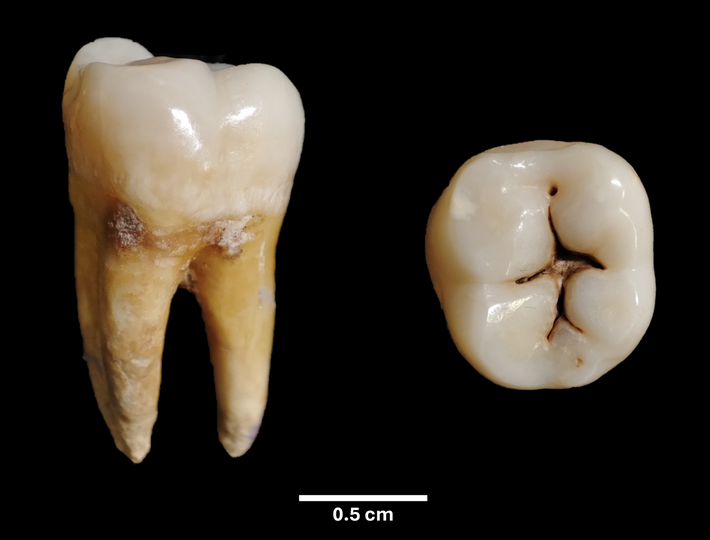
Pontecagnano, located in the province of Salerno, was a major centre in southern Italy. During the "Orientalising period" (720–580 BC), the region saw significant economic expansion and increased cultural contact with the Greek world, leading to greater social complexity and inequality. Within this broader context, the analysis explores the lives of individuals from the Iron Age from childhood onwards, showing how social and cultural change shaped their lifestyles.
“The Pontecagnano site offers a unique opportunity to uncover biocultural responses to the social and environmental challenges that emerged during the Orientalising period, when boundaries, political balances, and networks across the Italian peninsula were being completely redrawn,” confirms Roberto Germano, a PhD student at Sapienza University of Rome and the study’s lead author. “These dynamics may have influenced the local population’s health and lifestyle, potentially through exposure to new pathogens and unequal access to resources stemming from the rise of new social hierarchies.”
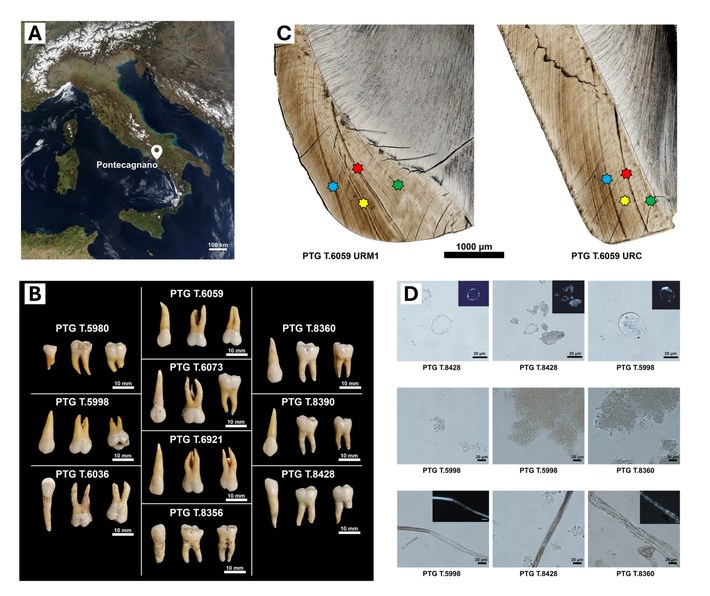
The researchers analysed a sample of thirty teeth belonging to ten individuals who lived in Pontecagnano between the 7th and 6th centuries BC. The study combined two distinct techniques: dental histomorphometry—a method examining the growth of dental tissues to reconstruct formation timelines and identify physiological stress events during childhood—and the analysis of micro-residues trapped within dental calculus, which reveals dietary patterns and lifestyle habits in adulthood.
This approach enabled the reconstruction of tooth formation timelines and the outlining of a chronology of physiological stress throughout childhood. The data also identified specific dietary traits of Pontecagnano’s ancient inhabitants. Traces of cereals, legumes, plant fibres, and yeast spores were discovered within dental calculus, suggesting the consumption of fermented products such as bread, wine, and beer.
“Formed through the mineralisation of plaque, dental calculus preserves a wide range of information regarding diet, oral health, and other facets of daily life,” explains Alessia Nava, Professor at Sapienza University of Rome and the study's coordinator. “Oral plaque can calcify within just two weeks; if left undisturbed, it can accumulate in layers over months or even years.”
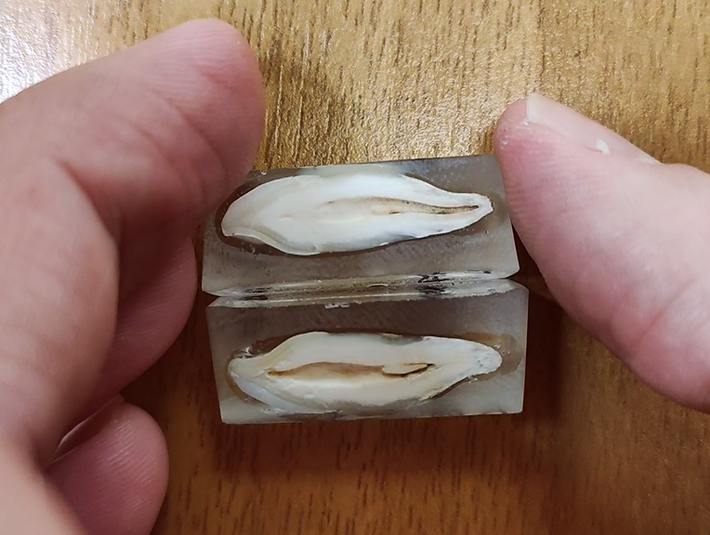
The consumption of cereals and legumes aligns with the diverse agricultural practices already known to have existed among ancient Italian populations. The damaged state of certain starch granules found in dental calculus also suggests food processing activities, such as cooking or the milling of seeds. Furthermore, the presence of caries in several of the analysed teeth indicates regular carbohydrate consumption.
In addition to these findings, numerous saccharomycete spores—yeasts associated with fermentation—were identified in the teeth of three individuals from Pontecagnano. Their abundance in the analysed calculus samples points towards the regular consumption of fermented foods or beverages.
“These findings must be viewed within the context of the broader socio-cultural transformations of the Orientalising period, when agricultural intensification and increasing contact with the Mediterranean world reshaped resource availability and dietary habits,” concludes Carmen Esposito, a research fellow at the University of Bologna’s Department of Cultural Heritage and one of the study’s authors. “The results allow us to build a more comprehensive picture of biocultural adaptation strategies in pre-Roman Italy and the wider evolution of Mediterranean societies at the time.”
The study was published in PLOS One as “Health and lifestyle in the Iron Age Italian community of Pontecagnano (Campania, Italy, 7th-6th century BCE)”. From the University of Bologna, contributors included Owen Alexander Higgins and Carmen Esposito, both from the Department of Cultural Heritage.
-
Owen Alexander Higgins
Owen Alexander Higgins is a Research Fellow in Bioarchaeology at the Department of Cultural Heritage. His research focuses on dental histology as a high-resolution biological archive. He integrates microstructural, histomorphometric, and elemental or isotopic analyses of dental tissues to reconstruct growth, health, diet, and mobility in past populations. His work spans the Palaeolithic through to the modern era, both in Italy and internationally.