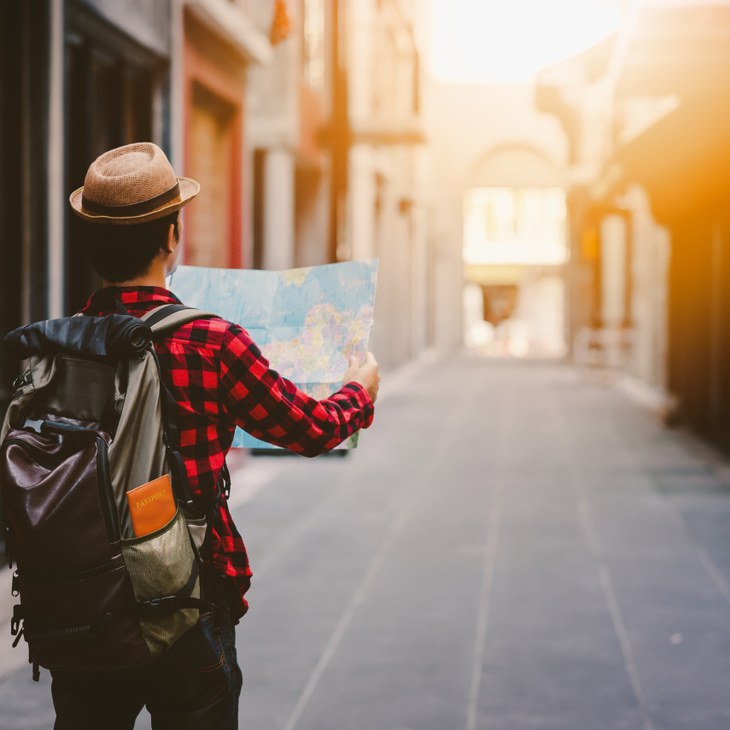
When we have to move around in a place we do not know, everyone, more or less consciously, relies on their own methods, strategies, and coping mechanisms. Much depends on the characteristics of the environment we are in, but there are also individual factors that make us more or less able to find – and find again – the right way.
We know that a number of gender stereotypes are associated with sense of direction, although they still need to be proven. We also know that there are genuine orientation disorders that can seriously affect many people’s quality of life.
UniboMagazine discussed all these issues with Raffaella Nori, Professor at the Renzo Canestrari Department of Psychology, whose research focuses on spatial memory.
Professor Nori, how do we find our way in a place we do not know?
There are certainly personal characteristics that influence our ability to orient ourselves, but first of all we need to consider the features of the environment we are moving through. In general, the more complex and information-rich a space is, the greater our cognitive load and, consequently, the greater the difficulty we have in finding our way. One helpful factor is the presence of clear, easily recognisable landmarks. And if we need to reach a specific destination, being able to see our final goal from a distance can definitely make a difference.
So what are the best strategies for finding our way?
There are three navigation strategies, which increase in effectiveness. The first is based on landmarks: when I am in an unfamiliar environment, I memorise a few distinctive features that I can use to move around. The next step , the second strategy , is to relate these different landmarks to one another, starting from where I am. This allows me to work out the direction I need to take to reach a particular place. Finally, the third and most advanced strategy involves the ability to visualise the environment from above: a true mental map that is independent of my current position.
There is a widespread gender stereotype according to which men are better at orientating themselves than women. How much truth is there in this?
Not much. There are some specific spatial tasks – such as mentally rotating a building in order to recognise it from an unfamiliar viewpoint – in which men appear to perform better in the short term. However, when more time is available to solve the task, this gender difference disappears. One difference that does emerge clearly is that men tend, on average, to be more confident when assessing their own sense of direction and their visuospatial abilities.
Some people experience major difficulties when moving around in an environment. Are there specific orientation disorders?
Leaving aside neurological conditions, which can of course affect spatial perception, the main disorder in this area is developmental topographical disorientation. People who suffer from it are unable to form mental representations of the environment they are in and, as a result, cannot use spatial orientation strategies. Some patients struggle even to move around inside their own home. Together with colleagues from Sapienza University of Rome, we have set up a free support service for people affected by this disorder and we are testing rehabilitation protocols.
What other orientation disorders can occur?
People with agoraphobia can certainly experience difficulties. The fear of crowded places or of spaces without escape routes leads them to focus on the elements that trigger the phobia, which prevents them from memorising the information they would need to orient themselves in the environment. Similarly, people who suffer from anxiety also have difficulties. There is, in particular, a form of anxiety known as spatial anxiety, which stems from the fear of getting lost. In this case too, fear prevents people from carefully encoding the elements they would need in order to find their way, thus fuelling further anxiety.
The spread of online maps and navigation systems has radically changed the way we move through space. Are they a help or a hindrance to our sense of direction?
At present, the scientific literature is divided on this issue. On the one hand, there is evidence showing that constantly relying on digital maps leads to a kind of mental laziness: we assume that the navigation system will take us to our destination and we do not train our own orientation skills. On the other hand, it is emerging that the people who use navigation systems the most are actually those who already have strong visuospatial abilities. This is a counterintuitive finding, which can be explained by a high level of confidence, particularly when driving. These people are able to move around independently: the navigation system is therefore mainly used to avoid traffic, monitor possible obstacles along the route and make sure they arrive on time.
Besides online maps, the other major digital revolution in orientation is virtual reality. How do we move in these artificial environments?
In much the same way as in the real world. We have seen that moving through virtual environments that share the same characteristics as real places requires the same cognitive abilities that we use to orient ourselves naturally in space. This can be a major resource, because it allows us to study more systematically which environmental and personal factors influence our ability to build mental representations of space.