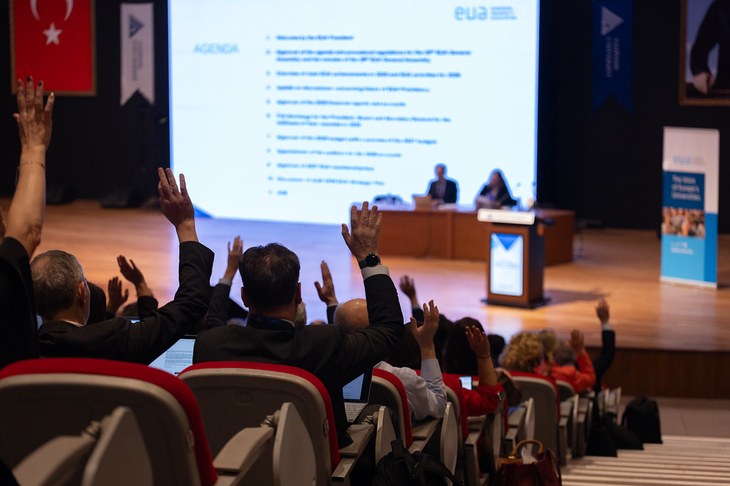
The Rector is taking part these days (15–17 April) in the General Assembly and annual conference of the European University Association, held this year in Istanbul at Yeditepe University. Founded in 2001, the European University Association, now brings together more than 850 members, including universities and national rectors’ conferences, across 48 countries. It fosters collaboration and dialogue on key issues shaping higher education policy.
The 2026 conference focuses on “University cooperation in changing contexts” and features both plenary sessions and parallel discussions addressing the major challenges universities are facing in an increasingly complex and fragile global environment.
The event opened with a roundtable specifically devoted to the demographic crisis affecting Europe, identified by the EUA as one of the most urgent issues requiring shared reflection. Invited speakers included Prof. Caspar van den Berg (President, Universities of the Netherlands), Prof. Bogumila Kaniewska (President of the Conference of Rectors of Academic Schools in Poland and Rector of Adam Mickiewicz University), and Rector Giovanni Molari. The speakers were asked both to outline the situation in their respective countries and to identify possible strategies to counterbalance negative trends that are likely to have an increasing impact on universities and society as a whole.
Drawing on data and reflections recently shared by the President of ISTAT, Francesco Maria Chelli, during his lectio magistralis at the inauguration ceremony of the University of Bologna’s academic year, the Rector first outlined the national scenario, highlighting its specific characteristics and internal differences. He then focused on the strategies, tools and lines of action to be adopted so that universities can remain true to their mission and strengthen their role even in a context of demographic decline. These include internationalisation policies and innovation in teaching, measures supporting the right to study, investment in facilities and services, as well as initiatives related to student guidance and relations with businesses. In closing, the Rector emphasised that all the efforts already undertaken by universities also require a clear assumption of responsibility and consistent, concrete and forward-looking support from local and national institutions.