“Proust y las Artes”: Giotto’s Frescoes in Photographs from the Supino Photo Archive, on Display in Madrid
Two photographic reproductions of the allegories of Vices and Virtues, made by Carlo Naya in 1865, are on display at the Thyssen-Bornemisza Museum as part of the exhibition dedicated to the great French writer

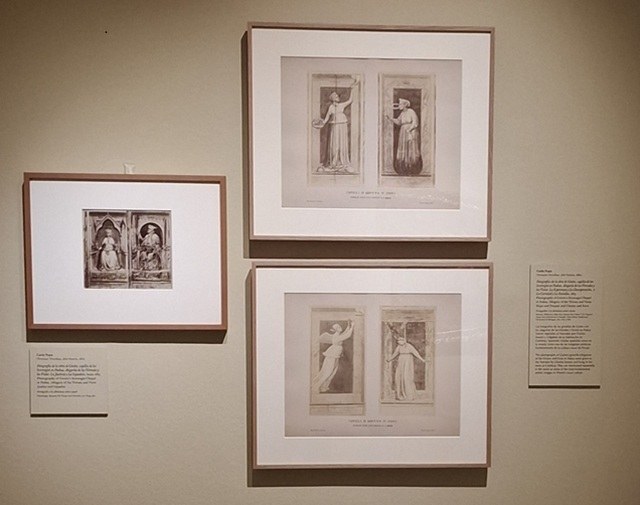
On 4 March, the Thyssen-Bornemisza Museum in Madrid opened the exhibition Proust y las artes, which will run until 8 June. A total of 136 works of various kinds — oil and panel paintings, sculptures, books, manuscripts, photographs, drawings, clothes and fabrics—are displayed to explore the connection between art and literature in the work of the great French writer. Two works preserved in the Supino Photo Archive of the University of Bologna’s Biblioteca delle Arti enrich the exhibition dedicated to the author of In Search of Lost Time, also known as La Recherche. These are the original photographic reproductions, made by Carlo Naya in 1865, of the allegories of Vices and Virtues painted by Giotto in the Scrovegni Chapel in Padua.
The four albumin prints document two pairs of allegories, Hope and Despair, Charity and Envy, images that are repeatedly cited in La Recherche as fundamental artistic images of Marcel Proust’s visual culture. As the narrator recalls, the reproductions of these allegories, a gift from Charles Swann, decorated his room in Combray. During his trip to Venice in 1900, Proust also visited Padua to admire Giotto's pictorial cycle.
Curated by Fernando Checa, former Director of the Prado Museum and a great connoisseur of Proust’s work, with the collaboration of Dolores Delgado, the museum’s painting conservator of early paintings, the exhibition spans over nine rooms, each dedicated to a key theme of the great Proustian novel.
Naya’s photographs are displayed in Room 3 —dedicated to the first volume of La Recherche, Swann’s way —alongside works by Corot, Monet, Vermeer, Tissot and other artists who have influenced the narrator’s cultural and artistic horizon.