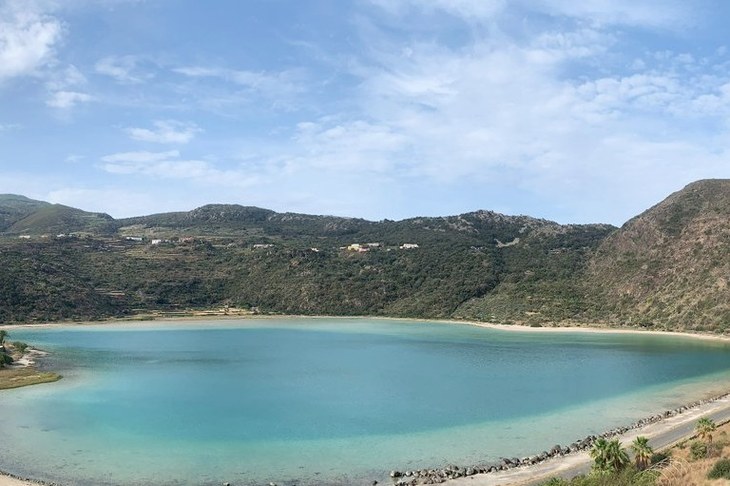
The guides of the Pantelleria National Park are studying astrobiology, together with the University of Bologna. The initiative stems from the HELENA – Habitat Estremi di Laghi vulcanici per l'Esplorazione Astrobiologica (Extreme Habitats of Volcanic Lakes for Astrobiological Exploration) project, funded by the Italian Space Agency, which places Pantelleria — and the Bagno dell'Acqua lake — at the heart of natural laboratory research into extreme environments and possible traces of life beyond Earth.
The 57 participants are guides working in the Pantelleria national park, who will gain up-to-date scientific knowledge to help them interpret and communicate to the public the significance of the extraordinary natural setting in which they work, placing it within the broader context of international astrobiological research.
"This initiative arises from the remarkable characteristics of the Bagno dell'Acqua lake, a natural environment on the island of Pantelleria with extreme geological and geochemical features that qualify it as a significant 'astrobiological analogue'," says Barbara Cavalazzi, professor at the Department of Biological, Geological and Environmental Sciences and coordinator of the HELENA project. "Environments of this kind are fundamental natural models for understanding processes and structures that could be present — whether in fossil form or as possible microbial life — on other planets and moons of the Solar System, such as Mars or the icy moons of Jupiter and Saturn."
For this reason, once the initiative has concluded, public events will also be organised for scientific dissemination and to raise awareness of one of the island’s most fascinating natural features.
The course was established with the support and collaboration of Italo Cucci, Extraordinary Commissioner of the Ente Parco Nazionale Isola di Pantelleria, Director Carmine Vitale, and Technical Biology Officer Andrea Biddittu, as well as Assimo Maris, co-organiser of the course and professor at the Department of Chemistry "Giacomo Ciamician" at the University of Bologna.
Alongside Professor Cavalazzi, the teaching activities involve lecturers and researchers from several academic and research institutions: Laura Zucconi and Fabiana Canini from the University of Tuscia, Monica Pondrelli from IRSPS – Università degli Studi "G. d'Annunzio" Chieti–Pescara, Federico Lucchi from the University of Bologna, and Giovannella Pecoraino from INGV – Palermo Section.