
Changes between past and future with the 22nd edition of the Festival of History
The 22nd edition of the International Festival of History returns, promoted by the University of Bologna together with its International Centre for the Didactics of History and Heritage – DiPaSt, part of the Department of Education Studies
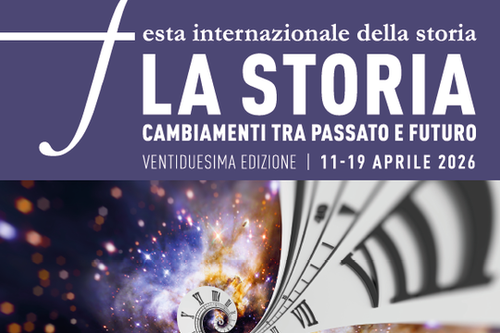
Now in its 22nd year, the International Festival of History will enliven the city of Bologna and its surrounding area from 11 to 19 April, with a wide-ranging programme of conferences, lectures, public talks, exhibitions, performances and activities for schools. “History. Changes between past and future” is the theme of the 2026 edition, focusing on the relationship between historical knowledge and contemporary transformations, with the aim of making history accessible to a broad audience and strengthening dialogue between the university, schools and the wider community.
For nine days, the festival will place change at the centre, understood as a continuous historical process that runs through eras and societies. Understanding these processes means recognising the deep roots of contemporary dynamics. Particular attention will be devoted to the relationship between past and future. Historical knowledge makes it possible to identify similarities, ruptures and discontinuities in turning points, offering valuable interpretative tools for navigating present-day transitions. From technological revolutions to environmental change, and the transformations of global societies, engaging with the past allows us to interpret the present with greater awareness.
The festival will bring together Italian and international scholars, with events focusing on major historical processes, collective memory and global challenges. There will also be a strong focus on young people, with educational initiatives and workshops designed to encourage active participation and critical thinking.
As in previous editions, the Festival will take place across numerous venues throughout the city and surrounding area, reaffirming its widespread format, which enhances cultural heritage and promotes the involvement of local institutions, including the Municipality and Metropolitan City of Bologna, as well as private companies such as Granarolo S.p.A. and collaboration with the Cineteca di Bologna.
Over the years, the Festival of History has established itself as one of Europe’s leading events for public history outreach, combining academic rigour with accessibility for the general public.
Across its previous twenty-one editions, more than 4,000 events have been held, with overall attendance exceeding 750,000 people and 3,600 active participants including speakers, performers, interpreters, choir members and musicians. The high quality of the events and the participation of thousands of contributors, including 7,200 university students since 2003 and 2,000 school classes of all levels since 2002, have made it the largest event of its kind in Europe.
The Festival is based on the active collaboration of a network of hundreds of organisations, with the aim of promoting awareness, protection and appreciation of the roots and antecedents of the present, addressing the most debated and topical issues in historiography, as well as themes related to the environment, the economy, relationships and communication. As further proof of the Festival’s prestige and importance, it has repeatedly been awarded the High Patronage or Representation Prize of the President of the Republic, as well as the patronage of all local authorities and institutions, including the Municipality of Bologna. Among the Festival’s various spin-offs are events held in Castel San Pietro Terme, Parma, Montechiarugolo and Montecchio, as well as international editions in the Spanish cities of Jaén, Seville, Zaragoza and Murcia, and in Buenos Aires, Argentina.
Full programme
The Festival will be held in various venues across the city and the surrounding area.