
The lost colours of Roman Tunisia
From the archives of the museums of Carthage and the Bardo, a remarkable collection of painted plasters has resurfaced, whose refinement rivals the celebrated examples of Pompeii

“Our goal is to restore these decorative complexes to both scientific knowledge and the wider public. For centuries they have been overshadowed by the greater durability of mosaics, yet they represented the true chromatic soul of Roman domus in North Africa”
From an extraordinary “excavation in the archives” of the museums of Carthage and the Bardo in Tunisia, a remarkable collection of painted plaster fragments has come back to light, whose refinement rivals the celebrated examples of Pompeii. This rediscovery of the colour culture of painted walls in Roman North Africa stems from a project supported by PNRR funding and led by Professor Antonella Coralini of the Department of History and Cultures at the University of Bologna.
The initiative brought together a multidisciplinary research team, co-directed with Nesrine Nasr of the National Heritage Institute of Tunis, to analyse hundreds of crates filled with fragments of painted plaster as part of an ambitious programme dedicated to the study and enhancement of materials preserved at the National Museum of Carthage and the National Bardo Museum.
“The analyses we carried out on these extraordinary artefacts revealed the use of rare and expensive pigments, such as cinnabar red,” explains Antonella Coralini. “Our goal is to restore these decorative complexes to both scientific knowledge and the wider public. For centuries they have been overshadowed by the greater durability of mosaics, yet they represented the true chromatic soul of Roman domus in North Africa.”
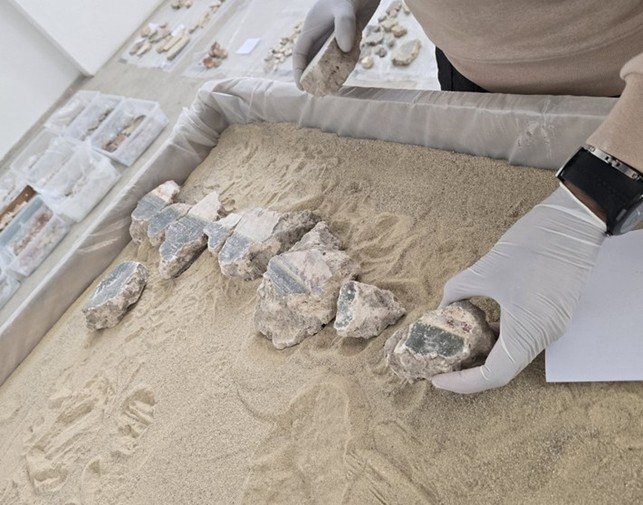
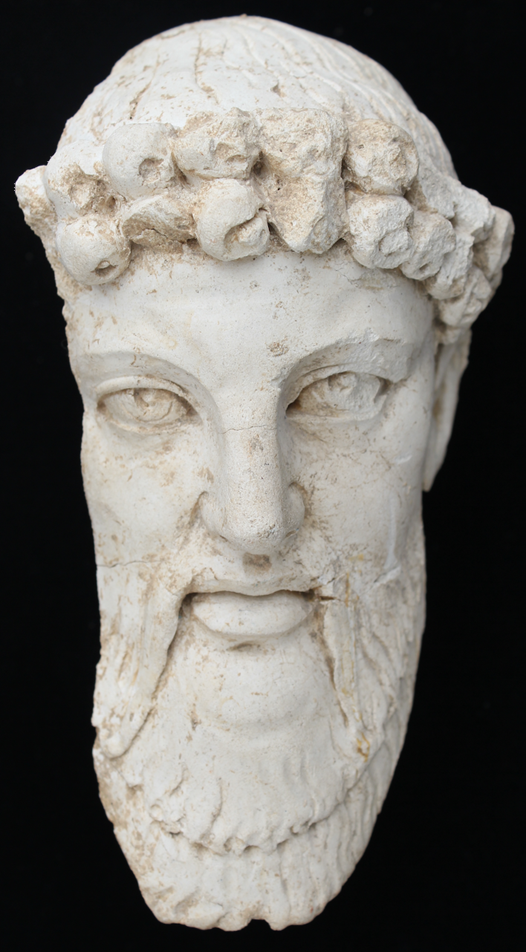
The work carried out by the research team has brought to light a series of decorations that blend imperial Roman canons with local tastes: mythological scenes, deities, heroes and lush gardens. Surfaces rich in colour that were designed to interact with the many mosaic decorations for which Tunisian buildings of the imperial period are particularly well known.
“Beyond its extraordinary mosaics, Tunisia also possessed equally remarkable wall decorations, which are now very rare due to the effects of time, weathering and demolition,” Coralini confirms. “Almost all buildings in Roman Tunisia had walls and ceilings covered with vividly coloured painted plaster, as was common in cities across the Empire.”
The project also became a true field laboratory for advanced training. Young Tunisian specialists, restorers and archaeologists worked side by side with the University of Bologna team, acquiring cutting-edge methods for the recovery, cleaning and consolidation of painted plaster. Thanks to this exchange of expertise, it will be possible to establish a local group of specialists capable of continuing the work of protecting and enhancing the country’s pictorial heritage, which is more fragile and less studied than its mosaic heritage.
The project’s work and its results were recently presented in Tunis at the Department of Archaeology of El Manar University, during a cycle of three lectures delivered by Professor Coralini. The conferences provided a valuable opportunity for exchange and reflection among teachers, researchers and students from Italy and Tunisia. The talks explored the forms of elite housing and wall paintings, with numerous case studies from Italy, beginning with the example of Pompeii.