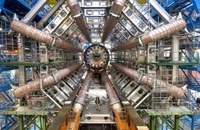
Artificial intelligence at CERN in Geneva to better understand the Higgs boson
The new ERC project ARTEMIS, coordinated by Viviana Cavaliere at the Department of Physics and Astronomy “Augusto Righi” of the University of Bologna, will use advanced neural networks to study the interactions of the Higgs boson

There are still many unanswered questions surrounding the Higgs boson, the elusive subatomic particle discovered in 2012 at CERN in Geneva. Today we know that it is responsible for giving mass to all other fundamental particles. But what happens when these particles interact with the Higgs boson?
The search for answers will be led by ERC ARTEMIS, a project funded by the European Research Council through a €2 million Consolidator Grant. The project will be headed by Viviana Cavaliere, currently a Senior Physicist at the Brookhaven National Laboratory in New York, who has chosen the Department of Physics and Astronomy “Augusto Righi” of the University of Bologna as the base for carrying out the research.
At the heart of the Large Hadron Collider (LHC), proton beams cross 40 million times per second, yet only a tiny fraction of these collisions is recorded. Selecting the truly interesting events in real time is extremely challenging. As a result, up to 50% of the collisions that could be relevant for studying Higgs boson interactions are discarded.
“With the ARTEMIS project, we aim to introduce a revolutionary approach to overcome these limitations, by using advanced machine-learning techniques for real-time event selection,” says Viviana Cavaliere. “Our goal is to observe the production of pairs of Higgs bosons and measure their self-coupling: a crucial step towards understanding profound phenomena such as the origin of mass, as well as what happened in the very first moments after the Big Bang.”
Thanks to these innovations, ARTEMIS aims to double the detection efficiency of these fundamental particle interactions, enabling measurements that have never been achieved before. The project will be carried out within the ATLAS experiment, one of CERN’s main detectors, where the University of Bolognais internationally recognised.
“This new approach, which makes use of advanced machine-learning techniques, aims to significantly improve our ability to measure Higgs boson interactions,” Cavaliere adds. “It is an ambitious goal, which we will be able to achieve thanks to the work of an independent research team committed to fostering new fundamental discoveries in particle physics.”