
Totalitarianism and democratic transitions: the University of Bologna expands its research network in Buenos Aires
A dual event hosted at the University of Bologna’s Centro de Altos Estudios (Centre for Advanced Studies) has led to the establishment of a new branch of the REFAT network, which incorporates researchers from Argentina and other Latin American countries, joining the existing groups in Italy, Portugal, Spain, and Brazil

What happens when a dictatorship ends? How does a regime transition into a new democratic institutional framework? These questions were explored by over forty scholars from international universities and academic institutions, including University of Bologna professors Riccardo Brizzi (DAR), Alessio Gagliardi (DISCI), Matteo Pasetti (DAR), and Francesco Davide Ragno (SPS).
The discussions took place during the conference “Dopo le dittature. Transizioni, eredità, memorie” (After dictatorships. Transitions, Legacies, Memories), held in two separate sessions at the Centro de Altos Estudios de la Universidad de Bologna in Buenos Aires. The first session was held from 5 to 7 November 2025, followed by a second meeting from 18 to 20 February.
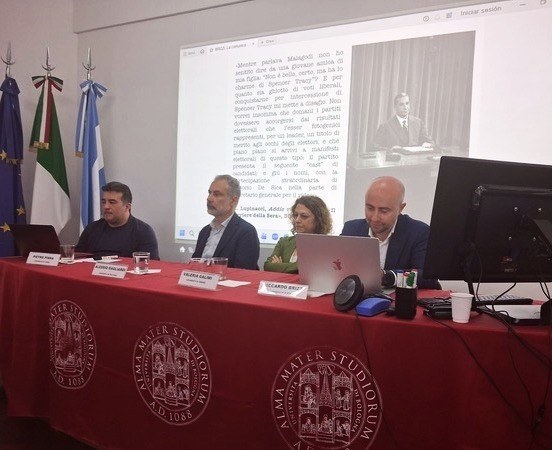
This forum for reflection on the recent past and the contemporary challenges facing democracies was promoted by REFAT, an international scholarly network led by the University of Bologna, which supports research into the history of 20th-century dictatorships and democratic transitions.
REFAT was established to encourage knowledge exchange and foster collaboration between researchers focusing on the history of fascism, authoritarianism, and totalitarianism and the transition to democratic systems. The two meetings in Buenos Aires served to consolidate relationships with academics from Argentina and other Latin American countries. These scholars will now form a new branch of the REFAT network, expanding its established presence in Italy, Portugal, Spain, and Brazil.