
The Power of the Cosmos in Pre-Columbian Astronomy
From architecture to interpretations of Venus’s movements in the Codex Cospi, held at the University Library of Bologna: how the pre-Hispanic peoples of Mesoamerica, without telescopes, interpreted the celestial sphere to define political and social order. UniboMagazine spoke with Professor Davide Domenici

If we imagine the sky as a vast cosmic clock, with the heavenly bodies marking the hours, the buildings constructed by pre-Hispanic societies can be seen as its hands: temples and palaces, precisely aligned with the risings and settings of celestial bodies, functioned as genuine scientific instruments
For the pre-Hispanic peoples of Mesoamerica, observing the sky was a practical, political and spiritual necessity. The astronomical data preserved in codices and hieroglyphic inscriptions, together with their sophisticated calendars, reveal how the movements of the Sun, Moon and bright planets were the sole means of measuring time and, consequently, of organising civic life.
Celestial space and earthly space were inextricably linked. If we imagine the sky as a vast cosmic clock, with the heavenly bodies marking the hours, the buildings constructed by pre-Hispanic societies can be seen as its hands: temples and palaces, precisely aligned with the risings and settings of celestial bodies, functioned as genuine scientific instruments.
“Through these alignments it was possible to monitor the seasonal cycle, plan agricultural activities and mark the rhythm of rituals that held the social fabric together. The correspondence between the orientation of buildings and astronomical events also served as a form of political legitimation, showing how the earthly order mirrored the cosmological order,” explains Davide Domenici, professor of Demo-Ethno-Anthropological Disciplines at the Department of History and Cultures of the University of Bologna.
The expertise of astronomers was vital to economic success and the stability of the political system. Being able to read the signs of the cosmos therefore meant ensuring order, preventing chaos and, above all, legitimising the power of those who ruled. The knowledge required to compile some of the astronomical tables that have come down to us from the pre-colonial past demanded generations of observations, the results of which were clearly passed down over time.
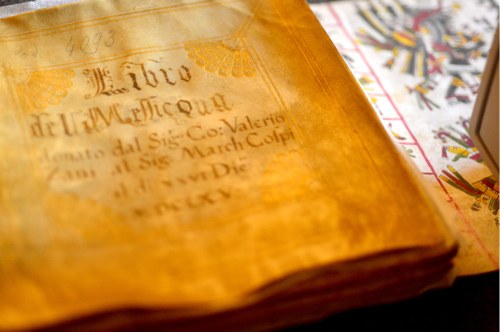
The stars provided a reliable guide, capable of “illuminating” everyday human life, but they were not without ambiguity. As celestial bodies, they also cast shadows: harbingers of disorder and omens of misfortune. One of the most important and feared was Venus, especially in its morning manifestation. The Codex Cospi – one of only fourteen pre-colonial manuscripts to have survived and now held at the Bologna University Library (BUB) – offers exceptional testimony to this view of the cosmos.
-
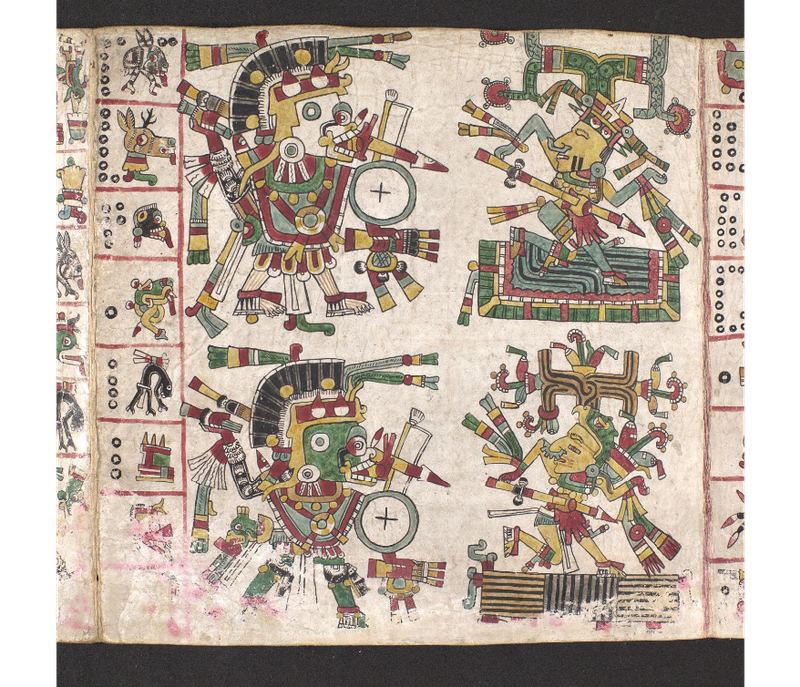
Codex Cospi – The Heliacal Risings of Venus
Recto 9
-
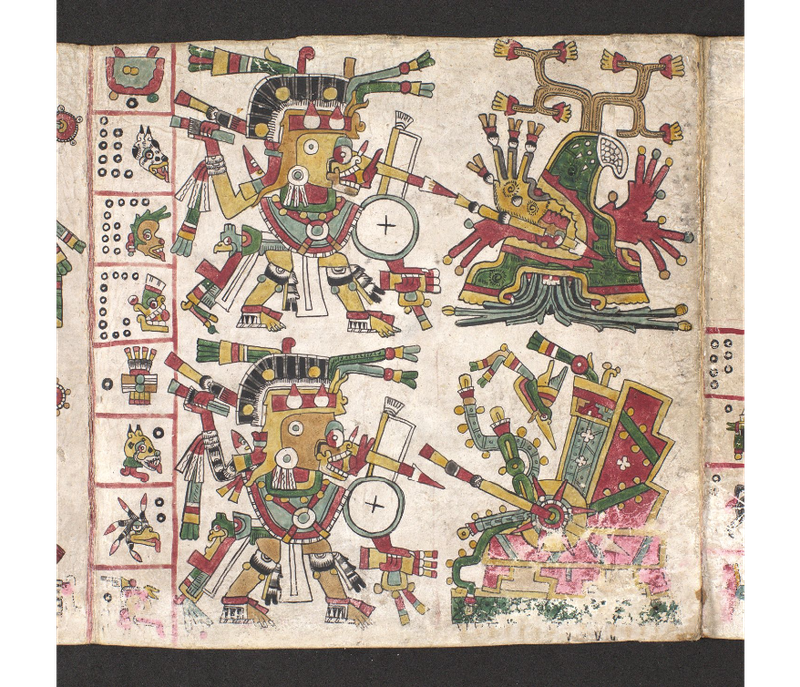
Codex Cospi – The Heliacal Risings of Venus
Recto 10
-
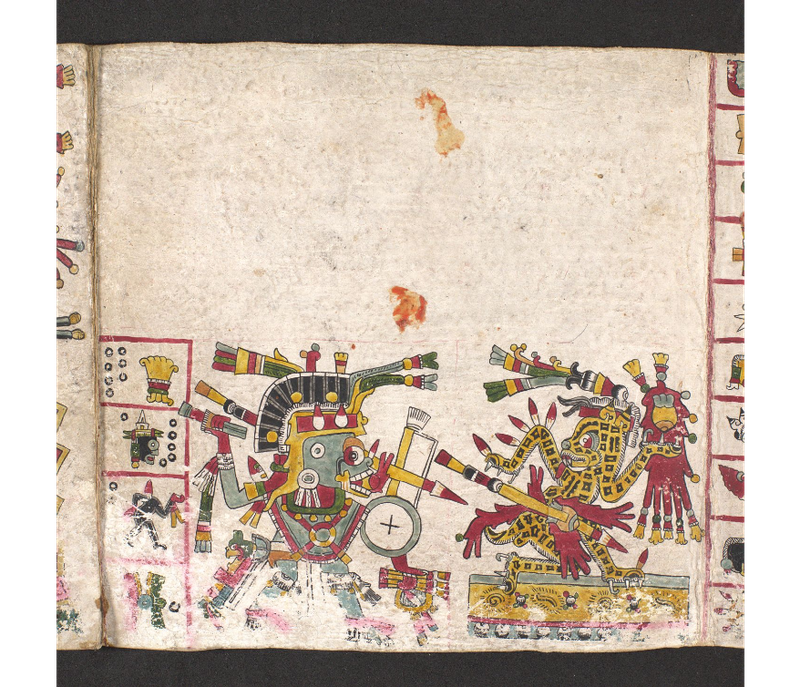
Codex Cospi – The Heliacal Risings of Venus
Recto 11
-
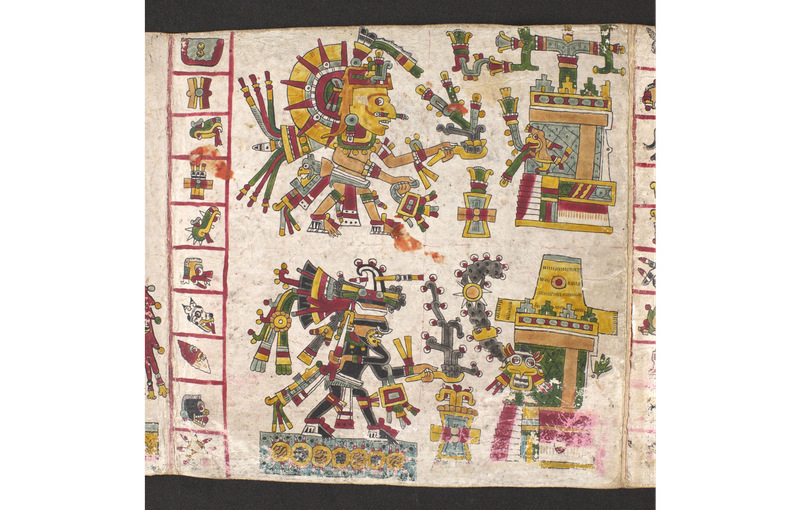
Codex Cospi – The Heliacal Risings of Venus
Recto 12
Within the Codex, a Nahua (“Aztec”) manuscript dating from the fifteenth to the sixteenth century, the section known as the “Venus Almanac” is devoted to the heliacal rising of the planet—the moment when Venus becomes visible again at dawn after a period of absence. This event was considered extremely dangerous in various Mesoamerican traditions and raises questions about its impact on local communities, how they sought to protect themselves from the first rays of the morning star, and which rituals were performed to avert danger.
“In its morning manifestation, Venus was known to the Nahua as Tlahuizcalpantecuhtli, ‘Lord of the House of Dawn’. It is likely that such events had no direct consequences for the lives of most of the population, but they were certainly taken very seriously at court and among the elite, where the interpretation of omens played an important role in planning all kinds of activities. We do not know what kinds of rituals were carried out, but Mesoamerican conceptions of events were certainly not based on the idea of an inescapable fate: offerings and other ritual practices undoubtedly aimed to ward off, or at least mitigate, the effects of astronomical events understood as bearers of adverse consequences,” Domenici continues.
In the pages of the Codex Cospi, Venus is associated above all with negative events, such as wars, famines and droughts. However, the planet’s cycle is inherently complex and ambivalent. There was also a positive, regenerative dimension linked to Venus that the Codex does not show: “For many Mesoamerican peoples, Venus – together with the Sun, often conceived as its twin – was a kind of instantiation of kingship. The planet’s cycle was also associated with the coming of the rains and thus with the fertilisation of the land. According to the Maya, for example, Venus and the Sun were the children of the Maize God. Just as the planet has two aspects to an earthly observer (morning and evening), so too were its effects ambivalent,” Domenici concludes.
-

Davide Domenici
Davide Domenici is professor of Demo-Ethno-Anthropological Disciplines at the Department of History, Cultures and Civilisations of the University of Bologna. A specialist in the anthropology, history and archaeology of the Indigenous Americas from the pre-colonial period to the early modern era, he has directed major archaeological projects in Mexico and the United States and has taken part in archaeological research campaigns in Nazca (Peru), Easter Island (Chile) and Teotihuacan (Mexico). His research interests include the study – using non-invasive scientific techniques – of pictographic codices and mosaics; the history of collecting Amerindian artefacts in Italy; and the history of Mesoamerican foodways.