
The Stories Hidden in the Ancient Fragments of Tattooed Skin
The analysis of the ancient artefacts preserved in the “Luigi Cattaneo” Anatomical Wax Collection of the University of Bologna has revealed a new perspective on the material and symbolic culture of the 19th century, including religious motifs and themes of a personal, amorous and erotic nature
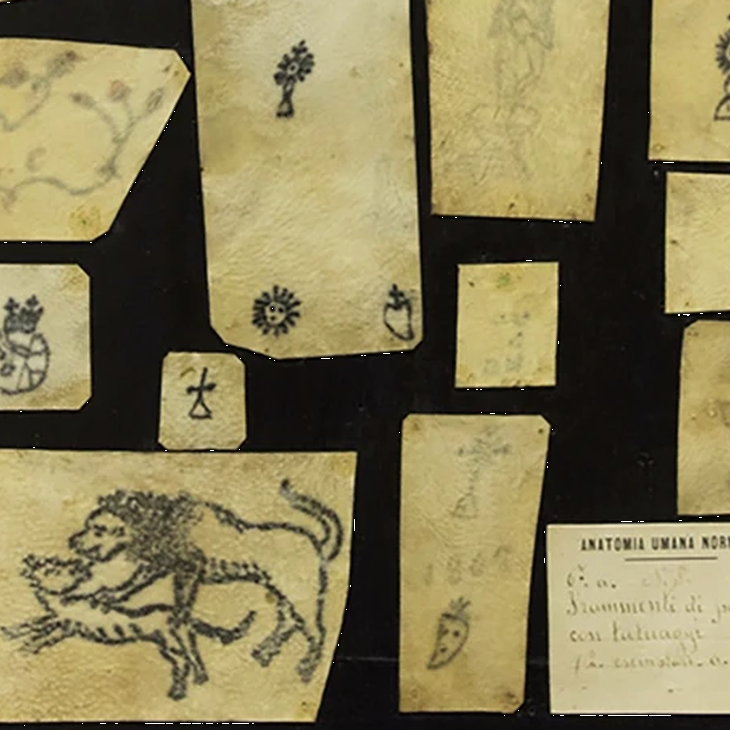
In the “Luigi Cattaneo” Anatomical Wax Collection of the University of Bologna people can find some tattooed skin fragments dating back to the 19th century. Where do they come from? How were they made? Why are they there?
By connecting anatomy, chemistry, conservation of cultural property, and anthropology, an interdisciplinary team of researchers analysed these unusual artefacts to find new answers. The operation involved researchers from the Italian Space Agency, the Department of Biomedical and Neuromotor Sciences and the Museum Network of the University of Bologna, the Department of Literary, Philosophical and Art History Studies of the University of Rome Tor Vergata, Elettra Sincrotrone Trieste, the Central European Research Infrastructure Consortium (CERIC-ERIC), the Post-Scriptum Laboratory, and the Abdus Salam International Centre for Theoretical Physics (ICTP).
“The analysed fragments are exceptional evidence of the evolution of tattooing from a popular and ritual practice to an artistic expression”, said Stefano Ratti, professor at the Department of Biomedical and Neuromotor Sciences of the University of Bologna and scientific supervisor of the “Luigi Cattaneo” Anatomical Wax Collection. “Furthermore, thanks to this study, for the first time we were able to define specific analysis, restoration, and conservation protocols for these extraordinary and fragile artefacts”.
Dating back to the 19th century, the analysed tattoos show a variety of subjects, including religious motifs, such as ex-votos of the pilgrimages to the Holy House of Loreto, but also personal, amorous and erotic themes: a new perspective on the material and symbolic culture of the time.
During this period, the millennia-old history of tattooing also concealed a dark and little-known phase, linked to the theories popularised by Cesare Lombroso. According to his ideas, now discredited, tattoos were in fact signs of an innate moral degeneration associated with criminals. Thus, fragments of tattooed human skin began to be preserved in museum collections dedicated to criminology, natural history and anatomy.
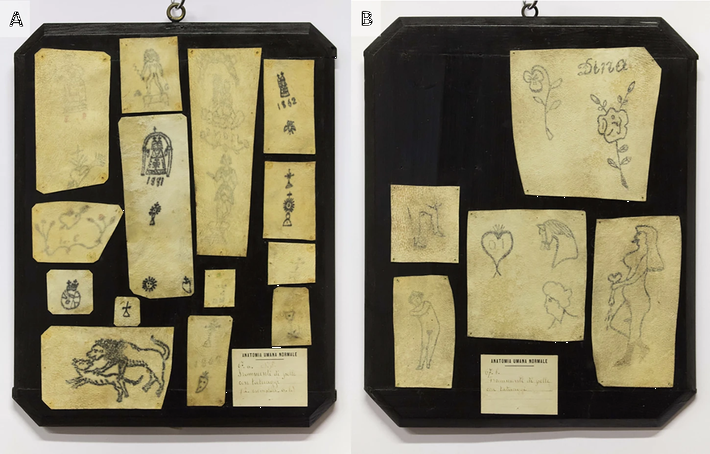
The artefacts preserved in the “Luigi Cattaneo” Anatomical Wax Collection of the University of Bologna were found some years ago in a storage space of the Department of Biomedical and Neuromotor Sciences, with few information about their origin. When the Museum of Cultures of Milan (MUDEC) requested to borrow them for the exhibition “Tattoo. Stories from the Mediterranean”, the researchers took advantage of the occasion to make a detailed analysis.
In particular, the research focused on three fragments of tattooed skin. By using non-destructive spectroscopic techniques, the researchers aimed to distinguish the used pigments and equipment, as well as their conservation, without compromising the integrity of the artefacts.
Thanks to the infrared spectroscopy (IR) and the X-ray fluorescence spectroscopy (XRF), available at the Elettra Sincrotrone Trieste and at the Abdus Salam International Centre for Theoretical Physics (ICTP), the researchers could trace back the origins of the used inks. The black ones were made using carbon-rich soot, probably produced by burning plant materials, whereas the brown ones presented natural earthy pigments, including iron and manganese. The red inks, instead, included traces of lead and mercury. This could be explained by the use of cinnabar, a natural pigment used since ancient times.
Analysis also showed traces of compounds of lime and zinc, which in the past were used in the museums to treat and preserve anatomical artefacts. The researchers also found traces of fungal activity: this marks the presence of ongoing deterioration processes in the skin fragments. This information allowed them to safely clean, stabilise, and reassemble the artefacts, improving the visibility of the tattoos while still honouring their historical authenticity.
“The performed analysis shows how physics applied to cultural heritage can be useful to define new study and preservation methods”, said Monia Valdrucci, supporter of the study and researcher at the Italian Space Agency. “It is an important breakthrough in the protection and study of old fragments of tattooed skin, a field which so far lacked well-established methodologies”.
The results of the research were published on npj Heritage Science with the title “Scientific analysis and preservation protocols for tattooed skin specimens from ‘Luigi Cattaneo’ anatomical wax collection”. Ester Orsini, Elisa Lodolo, Cristina Nisi and Stefano Ratti participated as representatives of the University of Bologna.
-

Stefano Ratti
Stefano Ratti is Professor at the Department of Biomedical and Neuromotor Sciences and Scientific Supervisor of the “Luigi Cattaneo” Anatomical Wax Collection which is part of the University Museum Network. He studies the cellular and molecular mechanisms of rare diseases in the neurodegenerative, oncological, cardiovascular and musculoskeletal fields and the development of precision medical technologies ranging from robotics to augmented reality and AI, starting from human anatomy, through international scientific collaborations.