
ROAR, the First “Made in Italy” Rotating Nanomotor, Is Unveiled: Powered by Light and Capable of Running in Reverse
Designed, built and tested by a research group at the University of Bologna, it is the only nanomotor in the world able to reverse its direction of rotation simply by changing the colour of the light source that powers it

“The most innovative feature of ROAR lies in its ability to reverse the direction of motion simply by changing the colour of the light supplied to the system”
ROAR is the first “made in Italy” rotating nanomotor and the only one worldwide capable of reversing its direction of rotation by changing the colour of the light that drives it. Its name stands for Reversible Optically Activated Rotary motor, and it was designed, built and tested by a research group at the University of Bologna.
Presented in Nature Chemistry, the new nanometre-scale molecular motor (on the order of billionths of a metre) is the result of a collaborative study carried out by the Center for Light Activated Nanostructures (CLAN), a joint research laboratory of the University of Bologna and the National Research Council (CNR) directed by Professor Alberto Credi, and the Computational Chemistry C2χ group of the Department of Industrial Chemistry “Toso Montanari” at the University of Bologna, coordinated by Professor Marco Garavelli.
The development of artificial rotating nanomotors is one of the most promising frontiers in chemical research, as these devices can perform a wide range of functions in technological and biomedical applications. Nanomotors could, for example, be used to create new materials for computing and robotics, to convert and store solar energy more efficiently, to enable new forms of chemical synthesis, or to support the development of new pharmaceuticals.
“Thanks to their ability to move directionally, these nanomachines can perform work when illuminated,” explains Massimiliano Curcio, a researcher at the Department of Industrial Chemistry “Toso Montanari” of the University of Bologna and one of the coordinators of the study. “In the molecule we designed, the absorption of a photon of light can cause the complete, unidirectional rotation of one part of the molecule—the rotor—relative to another—the stator.”
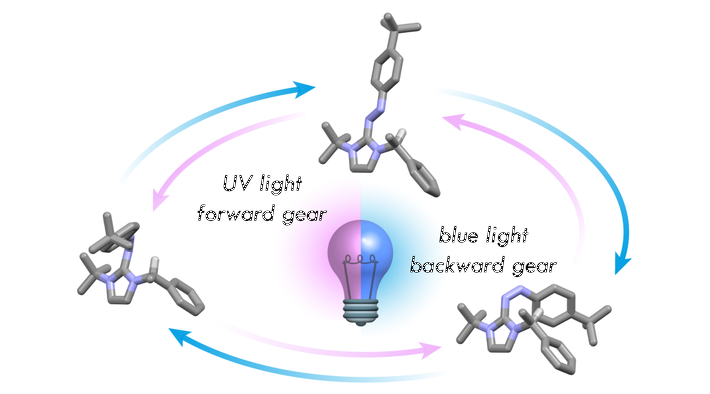
ROAR is a molecule that is easy to synthesise and initially has a linear shape. When exposed to light, it changes its structure by bending the rotating fragment towards the stator unit. Illumination promotes the continuous interconversion between three forms of ROAR—linear, bent to the right and bent to the left—through two distinct and sequential movements that together result in a spatially oriented rotation.
“This rotation can be likened to the movement a dancer makes when performing a pirouette,” explains Massimo Baroncini, professor at the Department of Agricultural and Food Sciences of the University of Bologna and one of the study’s coordinators. “Starting from the linear form, a vertical movement leads to the left-bent form, which then, through a horizontal movement, shifts to the right-bent form. This in turn performs a second vertical movement in the opposite direction, returning to the initial linear form.”
ROAR also possesses a unique feature that sets it apart from other nanomotors of this kind: by changing the colour of the light used to activate it—and therefore its wavelength—the direction of molecular rotation can be reversed.
“The most innovative aspect of ROAR lies precisely in its ability to reverse the direction of motion simply by changing the colour of the light supplied to the system,” confirms Luca Muccioli, professor at the Department of Industrial Chemistry “Toso Montanari” of the University of Bologna and one of the study’s coordinators. “This mode of operation, which is characteristic of biological systems, has long been sought by scientists. We have now succeeded in achieving it by exploiting the different interactions with light of the two bent forms that ROAR can assume.”
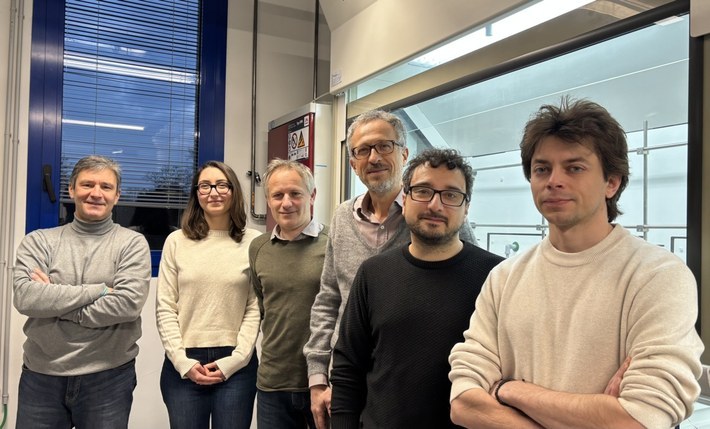
The fundamental principle underlying research on molecular motors is the construction of devices that resemble those used in everyday life, such as machines and engines, but on a scale one billion times smaller. From this perspective of “nanometre-scale engineering”, molecules and chemical processes correspond to macroscopic components and their assembly, while the fuel is represented by the energy input—reagents, electricity or light—required to operate the system.
ROAR is the outcome of a project launched three years ago, building on a long-standing line of research within the Center for Light Activated Nanostructures (CLAN), a research centre at the forefront of the international scientific landscape. Researchers are already looking ahead to future developments, including new, more efficient ROAR prototypes capable of harnessing visible and infrared light—abundant in sunlight and compatible with biological systems.
In the long term, the aim is to integrate ROAR into high-tech systems such as smart materials for solar energy conversion and storage, mechanical actuators for soft robotics, and biomedical systems capable of performing functions on demand in response to light-based inputs.
The study was published in Nature Chemistry under the title “Wavelength-Steered Directional Rotation in an Autonomous Light-Driven Molecular Motor”. The authors, all from the University of Bologna, are Federico Nicoli, Chiara Taticchi, Emilio Lorini, Sara Borghi, Flavia Aleotti, Serena Silvi, Alberto Credi, Marco Garavelli, Luca Muccioli, Massimo Baroncini, Massimiliano Curcio.