
New Archaeological Discoveries in the Ancient Roman City of Suasa
The excavation campaign led by the University of Bologna has brought to light a vast production district that stretched along the main road, with structures extending more than five metres deep, together with an extraordinary quantity of coins and several almost intact vases
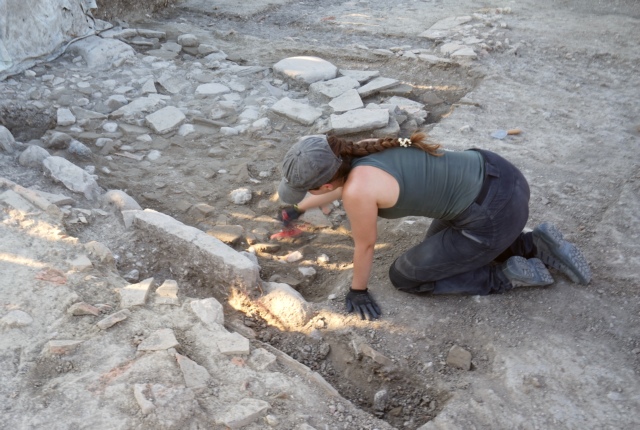
In the ancient Roman city of Suasa, in the province of Ancona, archaeologists from the University of Bologna have uncovered a wide production quarter that developed along the main road.
The discovery came during the latest excavation campaign at the archaeological site in the Marche region, involving around forty students from the Departments of History and Cultures and of Cultural Heritage at the University of Bologna.
“The aim of this year’s research was to investigate the boundaries of the city, in order to better understand the transition between the settlement and the necropolis. We began with a preliminary campaign of non-invasive investigations, using drone photography and geophysical surveys,” explains Enrico Giorgi, professor at the Department of History and Cultures at the University of Bologna, who directs the archaeological mission. “The subsequent excavation campaign then allowed us to uncover a large production district, with structures extending more than five metres deep, together with an extraordinary quantity of coins and several almost intact vases”.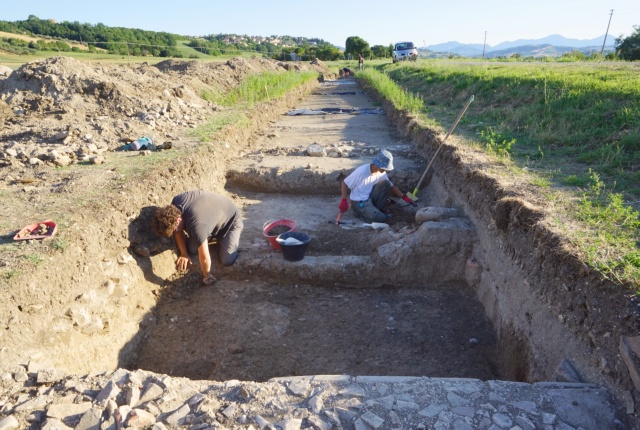
Carried out in agreement with the Superintendency of Archaeology, Fine Arts and Landscape for the Provinces of Ancona and Pesaro-Urbino, and with the support of the Municipality of Castelleone di Suasa and the Alma Scavi Project of the University of Bologna, the research was conducted in collaboration with Ilaria Venanzoni (Superintendency), and directed on site by Alessandro Campedelli and Anna Gamberini.
The Roman city of Suasa, located in the middle valley of the Cesano River (in the Marche hinterland, north of Ancona), was founded after the Battle of Sentinum in 295 BC. In this battle, the Roman army and the Picentes faced an alliance that included the Etruscans, Samnites, Senone Gauls and Umbrians. The Romans won, and the outcome proved decisive for their control of Central Italy.
Suasa was initially a moderately important administrative centre but grew over time thanks also to the presence of two key Roman roads that crossed its territory: the Via Flaminia and the Via Salaria Gallica. Its period of greatest expansion was in the second half of the 1st century BC. At that time, the city became a Municipium, a civic community linked to Rome but with its own autonomous government and magistrates, and several monumental public and private buildings were erected on its territory.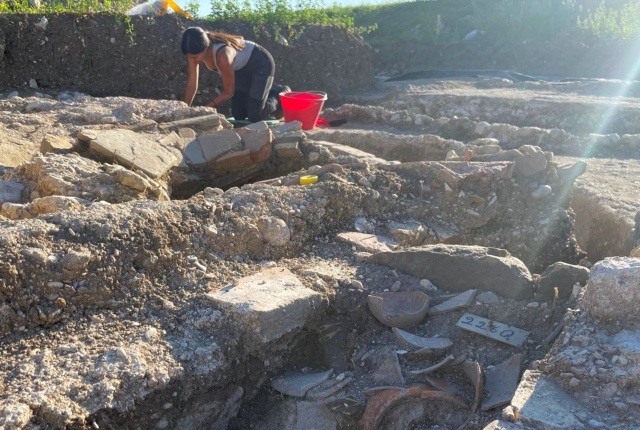
The University of Bologna’s archaeological mission, which began in 1987, has over the years brought to light many of these works. In the ancient city centre, a Domus from the mid-Imperial age has emerged, with mosaics and wall paintings, as well as a large Commercial Forum, with a square and a horseshoe-shaped portico. There is also the Amphitheatre, the largest in the Marche region, and not far away, aerial photography has revealed the existence of a Theatre.
The archaeologists’ investigations have also located the Necropolises connected to the city, and it is precisely in the outer area of the site, between the settlement and the burial grounds, that the most recent excavations have been concentrated, leading to the discovery of the new production district.
Suasa continued for a long time to be an important administrative and economic centre in Central Italy, reaching the height of its development in the 2nd century AD, during the mid-Imperial period. From the second half of the 3rd century onwards, however, signs of decline began to appear. The city was gradually abandoned and eventually depopulated entirely by the 6th century, as people moved to new settlements on the nearby hills.
In primo piano
-

L’Università di Bologna è la più sostenibile d’Italia, e tra le prime dieci al mondo
-

La Pantera siamo noi: il movimento studentesco del 1990 in mostra a Bologna
-

Due giorni di festa per le dottoresse e i dottori di ricerca dell’Università di Bologna
-

Due professori ricevono il premio Rimini Mundi 2025
-

Voci, saperi, patrimoni. Dall’Amazzonia al Museo, fra Modena e Bologna