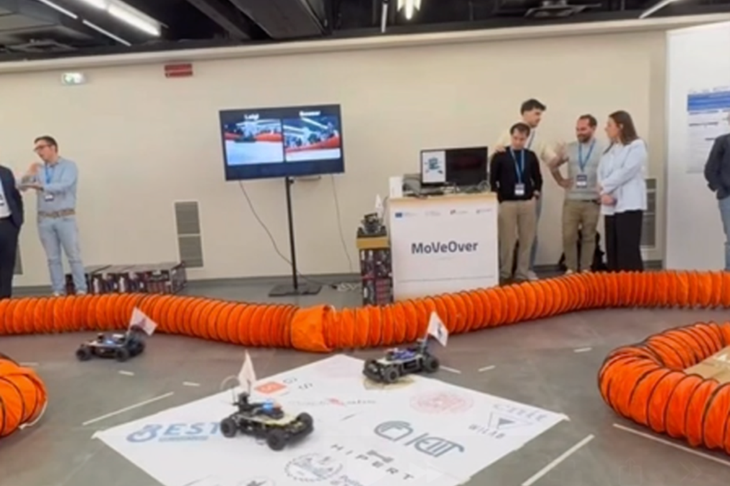
Four 1:10-scale vehicles — autonomous, connected and cooperative — travelled along an 8×10-metre figure-of-eight test track. At the centre of the circuit was a road junction, which the vehicles negotiated by coordinating with each other, without ever stopping.
This is what the MoVeOver project demonstrated. The project is coordinated by Alessandro Bazzi, professor of Telecommunications at the Department of Electrical, Electronic and Information Engineering “Guglielmo Marconi” (DEI) at the University of Bologna.
Led by Lorenzo Farina, a PhD candidate in Automotive Engineering for Intelligent Mobility at the University of Bologna, the demonstration was awarded first prize among more than one hundred entries in the “New Applications” category at the closing event of Restart, a research programme funded under Italy’s National Recovery and Resilience Plan (PNRR).
Thanks to the automation and connectivity systems installed on board the miniature vehicles, together with the junction management algorithm developed within MoVeOver, the cars were able to pass through the intersection smoothly and safely, repeating the experiment several times under the watchful eye of attendees.
Over the past three years, Restart has brought together universities and industry with the aim of shaping the future of telecommunications in Italy. With total funding of more than €100 million, the programme has involved over 130 academic and industrial partners, organising its work into 32 research projects and seven thematic missions.
At the programme’s final event — held in Rome from 19 to 21 January and attended by policymakers, researchers and industry representatives — the main results were presented and future challenges in digital technologies and communications were discussed.
MoVeOver is the result of a collaboration between the University of Bologna, Hipert Srl, the Polytechnic University of Turin, the National Research Council (CNR), the University of Padua, WindTre, the Gran Sasso Science Institute and the University of L’Aquila, with additional contributions from CNIT WiLab, the University of Modena and Reggio Emilia and RadioLabs.
Further information is available at the links below:
a description of the project
the activities of some young researchers
the technical preparation of the demonstration