

The Search for Life on Mars Begins in Ethiopia
The Allalobad geothermal field is a “Martian analogue”: its extreme conditions resemble those that might have existed billions of years ago on the surface of Mars. In this extraordinary and inhospitable place, a research team led by the University of Bologna is working to understand how and where to look for traces of extraterrestrial life
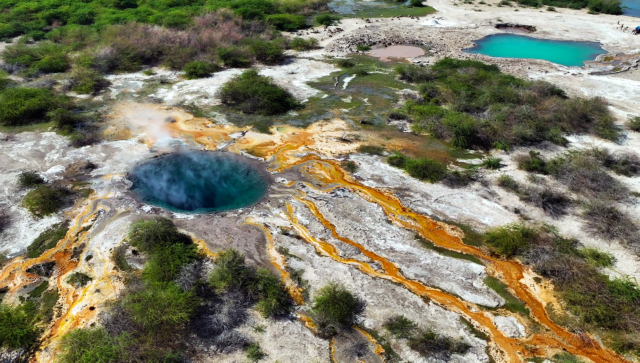
The Allalobad geothermal field, in the Afar region of Ethiopia
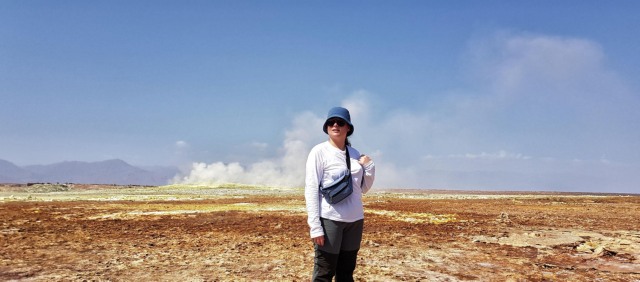
As soon as the car door opens, a wave of hot air engulfs everything. Under a blazing sun and a vast blue sky, the landscape looks like something out of an old science fiction movie. Dozens of pools of boiling water shimmer under a greenish film. Long, yellow, foamy streaks stretch across the ground. Sudden jets of steam rise from the soil, while in the distance sharp rocks glow red and orange. It feels like landing on an alien world. — and that is precisely the point.
We are in the Allalobad geothermal field, in the Afar region of Ethiopia. A place identified as a “Martian analogue”, because its extreme characteristics — temperature, acidity, and metal concentration — are similar to the conditions that may have existed on Mars billions of years ago, when primitive forms of life might have developed up there.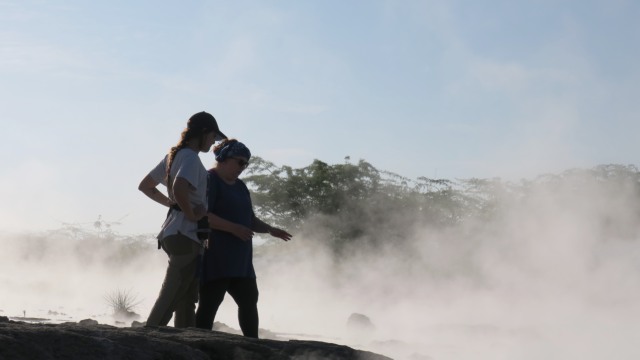
Barbara Cavalazzi and Rebecca Martellotti in the Allalobad geothermal field
“Allalobad is an extraordinary natural laboratory for studying possible traces of extraterrestrial life: here we can observe how biological activity develops and spreads under extreme conditions, and what evidence remains once that activity has ceased,” explains Barbara Cavalazzi, astrobiologist and professor at the Department of Biological, Geological and Environmental Sciences at the University of Bologna. She has been visiting sites like this for years in search of the most extreme conditions in which life can emerge — research that begins on our planet but looks to space, and to Mars in particular. “We know that billions of years ago there was liquid water on Mars,” she says, “and we expect there were geothermal systems very similar to this one. Studying the Allalobad site can help us understand where to look for, and how to collect, possible traces of Martian life.”
Together with the University of Bologna, the project — called HELENA — involves researchers from the International Research School of Planetary Sciences (IRSP), the University of Tuscia, and the Palermo Section of the National Institute of Geophysics and Volcanology (INGV). The perspective is that of upcoming space missions to Mars — starting with ExoMars, through which the European Space Agency will land a rover capable of analysing Martian rock samples that could contain traces of life. Plans are already being discussed for future missions to retrieve those samples and bring them back to Earth.
“Today we can reach Mars with a rover and collect samples from its surface to study,” says Cavalazzi. “But the real question is: which samples should we choose? How can we tell which ones might contain traces of life? The study of Martian analogues we are conducting is designed precisely to answer that.”
The bright colours that give the Allalobad geothermal field its alien appearance come from the biological activity that thrives around the hot springs, fumaroles and geysers. Each colour corresponds to a microbial species able to survive under specific and extreme conditions of temperature and acidity.
“Thanks to the exceptional conditions at the Allalobad site, we can study which organisms are capable of living along extreme gradients of temperature, acidity and other parameters,” explains Cavalazzi. “We can also find fossil traces of this diverse microbial activity — all key elements that help us understand how to select the right samples to collect on the surface of Mars.”
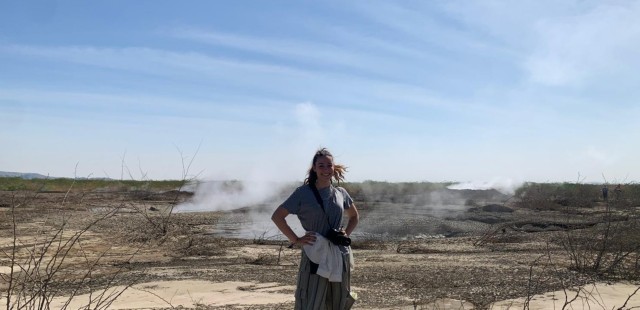
Rebecca Martellotti, PhD candidate in Astrobiology
Conducting research in places like Allalobad is anything but simple. Extreme temperatures, unstable marshy terrain and very high acidity make life difficult for researchers.
Rebecca Martellotti knows this well. She is pursuing a PhD in Astrobiology at the University of Bologna and took part in the first research campaign in Allalobad last January. “We wake up at four to reach the site by dawn and work in the early morning hours — later it becomes too hot,” she says. “And you have to watch every step, because there’s always the risk of falling into a pool of boiling water.”
Originally from La Spezia, Rebecca came to Bologna to study Biological Sciences, moved to Trieste for her Master’s degree, and then returned to the University of Bologna for her doctorate. “I always wanted to be a biologist, and in high school I discovered astrobiology — I was immediately fascinated,” she says. “From then on, I looked for degree programmes focusing on that field, and here I am.”
Before travelling to Ethiopia, she had already taken part in fieldwork in Pantelleria, where the HELENA project team studies bacterial activity near a volcanic lake. Then came the Allalobad sampling campaign. “It was demanding both physically and mentally, but also incredibly exciting,” she recalls. “Every day brought a new discovery, and I couldn’t wait to start again the next morning.”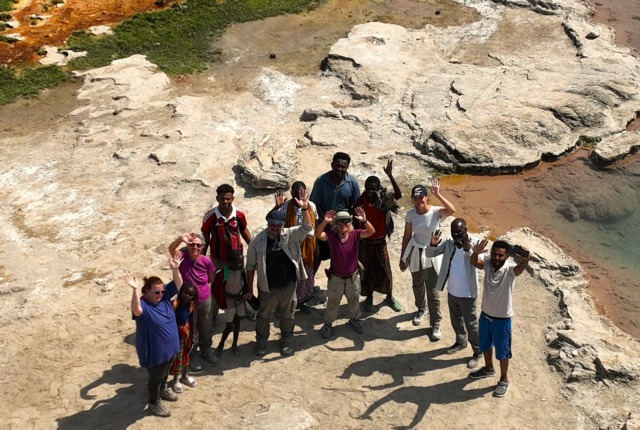
When exploring these remote and unique areas, researchers always work alongside local guides, who know which paths to take and which places to avoid — a way not only to reduce risks, but also to build valuable connections with local communities. “Respect for local inhabitants is a central part of our research campaigns,” says Barbara Cavalazzi. “We don’t just want to arrive, collect samples and leave: we want to meet the people who live in these regions and involve them in our work, also by cooperating with local universities and researchers.”
These connections are also crucial for learning how to adapt to such particular environments. Keeping water always within reach, watching every step, and showing a fair amount of creativity in handling equipment are essential rules. “Given the extreme acidity levels found in places like Allalobad, anything metallic wears out very quickly,” says Cavalazzi. “In the past we’ve had problems with batteries, cables, cameras, and even standard tools like hammers and pliers. Only through experience and constant exchange have we gradually found solutions that allow us to carry out our work without unexpected setbacks.”
Liliana Balotti studied Natural Sciences and took part in a research expedition to Ethiopia
It remains an extraordinary fact: in a place that seems utterly inhospitable to us, life is not absent — on the contrary, it thrives in a multitude of microorganisms. Observations like these suggest that something similar might also occur on other worlds.
“Trying to understand which elements are necessary to ignite the initial spark of life fascinates me enormously,” says Liliana Balotti, who took part in a research campaign in Ethiopia during her studies in Natural Sciences at the University of Bologna. Liliana collected and analysed samples of modern stromatolites — an analogue of the oldest fossil evidence of life forms on our planet. “There was a time when Earth and Mars shared similar conditions, and we know that, on Earth, life developed during that period. This suggests that organisms of the same kind might once have emerged on Mars too.”
Liliana’s passion for extreme environments, however, goes beyond astrobiology — it reaches directly into space. In addition to being a student and young researcher, she is also an analogue astronaut. “I’ve always been fascinated by space, and one of my dreams is to become an astronaut,” she confirms. “So, I applied to take part in a simulated lunar mission — and I was selected.”
For one week, Liliana lived like an astronaut, experiencing isolation from the outside world, managing limited resources, and adapting to a daily routine very different from her usual one. “An astronaut in space can also be seen as a form of life in an extreme environment,” she explains. “Missions like this are designed to understand how human beings react when exposed to particular physical, environmental, and psychological stress conditions.”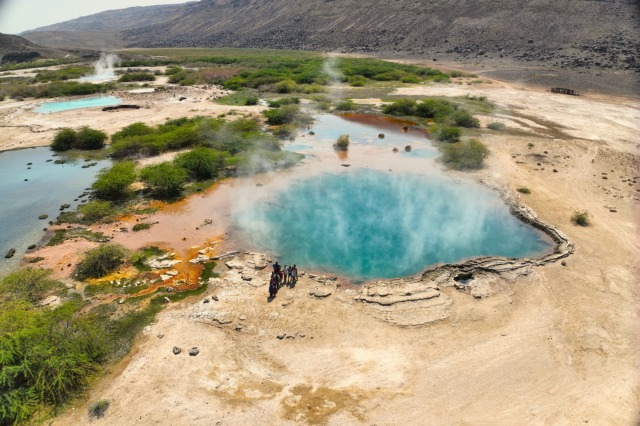
Those who study astrobiology, after all, inevitably turn their gaze to space — and to Mars in particular. For it is there that we might find answers not only about the possible existence of extraterrestrial life forms, but also about the origins of life on our own planet.
And the story of Mars may also teach us something about our future. “At a certain point in its evolution, Mars began to lose the water on its surface, until it became completely desertified: if life ever existed, it must have disappeared at that stage,” says Barbara Cavalazzi. “This should remind us that there is no such thing as a ‘Planet B’. Even if we were to find a habitable exoplanet in another solar system, it would still be a very long time before we had the technologies needed to reach it. We must therefore hold on to our world — care for the Earth and preserve the extraordinary conditions that make life possible.”
The HELENA project is led by Barbara Cavalazzi (Department of Biological, Geological, and Environmental Sciences – BiGeA, and CIRI Aerospace), with the participation of Sandra Cristino, Federico Lucchi, and Marco Cantonati from BiGeA, and Assimo Maris from the Department of Chemistry “Giacomo Ciamician.” Also collaborating are Rebecca Martellotti, Marlisa De Brito, Luna Girolamini, and Alice Tarozzi, young researchers from BiGeA.
The project also involves the IRSP – International Research School of Planetary Sciences (co-PI Monica Pondrelli), the University of Tuscia (co-PI Laura Zucconi Galli Fonseca), the INGV – Palermo Section (co-PI Giovannella Pecoraino), and Luca Lupi, an expert on the Danakil region.
In primo piano
-

L’Università di Bologna è la più sostenibile d’Italia, e tra le prime dieci al mondo
-

La Pantera siamo noi: il movimento studentesco del 1990 in mostra a Bologna
-

Due giorni di festa per le dottoresse e i dottori di ricerca dell’Università di Bologna
-

Due professori ricevono il premio Rimini Mundi 2025
-

Voci, saperi, patrimoni. Dall’Amazzonia al Museo, fra Modena e Bologna