Global cluster no more
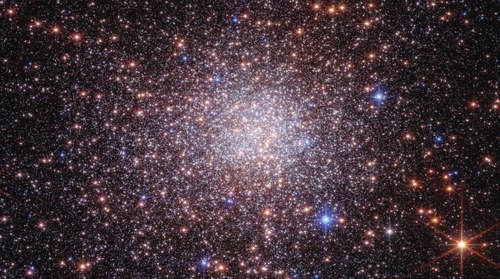
A new analysis based on observations from the James Webb Space Telescope suggests that Terzan 5, long considered a globular cluster, may instead be a kind of living archaeological relic of the birth of our galaxy
252 Articles
A new analysis based on observations from the James Webb Space Telescope suggests that Terzan 5, long considered a globular cluster, may instead be a kind of living archaeological relic of the birth of our galaxy
With more than 60 million stars, the image could help confirm the existence of exoplanets and measure their masses through variations in starlight
A study identifies the brain mechanism that links expectations to confidence in our decisions in the alpha oscillations of the right parietal cortex
The analysis of a fossil humerus preserved in the Geology Collection “Museo Giovanni Capellini” of the University of Bologna documents one of the oldest known cases of healing from a severe fracture in cave lions. The study, led by the University of Padua, provides rare insights into the lives and survival strategies of the great predators of the Pleistocene
A team of students from the University of Bologna has been selected to trial a multi-robot orbital system for space debris removal at the Orbital Robotics Laboratory of the European Space Agency
A new study suggests that the presence of extraoral soft tissues — labial scales or "lips" for short — was not unique to extant lepidosaur reptiles (lizards, snakes, and tuataras), but rather represents the primitive condition for all reptiles, including archosauromorphs that lived during the Triassic period more than 240 million years ago
The University of Bologna contributed to the study, which traces the evolution of filamentary structures of galaxies back through time, up to when the universe was just one billion years old
A new study reveals that deep within our planet, certain minerals reacting with molecular hydrogen (H₂) can produce water molecules. This has implications for magma formation, seismic activity, and even the search for extraterrestrial life
A University of Bologna research team has helped develop a smart mask for continuously and non-invasively monitoring astronauts’ sleep quality
New frontiers in chemistry to address the challenges of climate, energy and resource scarcity, and research as a shared human effort serving equality and sustainability
During the Holocene, between 2,000 and 8,000 years ago, the melting of ancient ice sheets caused the Earth’s axis of rotation to shift, thereby altering sea levels across the entire planet
There were at least seven individuals, who lived around 100,000 years ago: the study – coordinated by scholars from the University of Bologna – stems from the analysis of ancient mitochondrial DNA from eight teeth found in the Stajnia cave in Poland
A survey of the main databases on the distribution of plant species has revealed that data are available for only 790 of the 2,217 islands considered: a gap that needs to be filled if we are to ensure the conservation of the region’s ecosystems
A team at the University of Bologna has developed a device capable of reproducing in the laboratory the oxygen gradients typical of human tissues. The technology, already patented and at the heart of an academic spin-off, opens new avenues for oncological research and the development of new therapies.
As part of the European BUZZ LIFE project – in which the University of Bologna is also a partner – a series of initiatives are being launched to ensure the survival and return of bees and pollinators to urban and peri-urban areas across Italy, Cyprus, France and Greece
A new multidisciplinary study, led by researchers at Unibo, Unimore and MUSE – the Trento Museum of Science, has reconstructed the evolutionary history and relationship with the environment of a population of Alpine ibex (Capra ibex) that lived in the mountains of Trentino more than 13,000 years ago